Head to head
MSI Claw 8 EX AI+ vs Lenovo Legion Go 2
By ElvisPublished
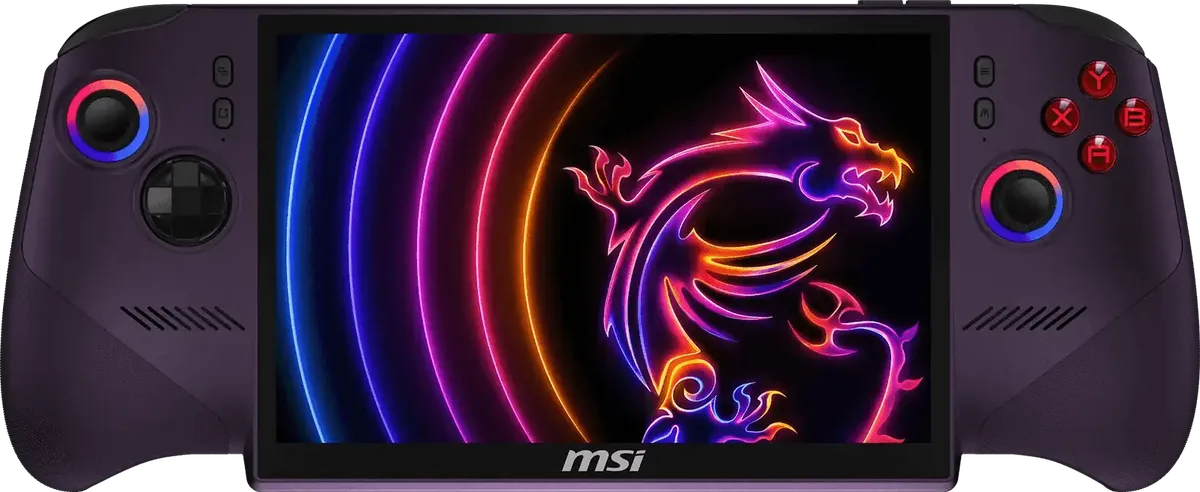
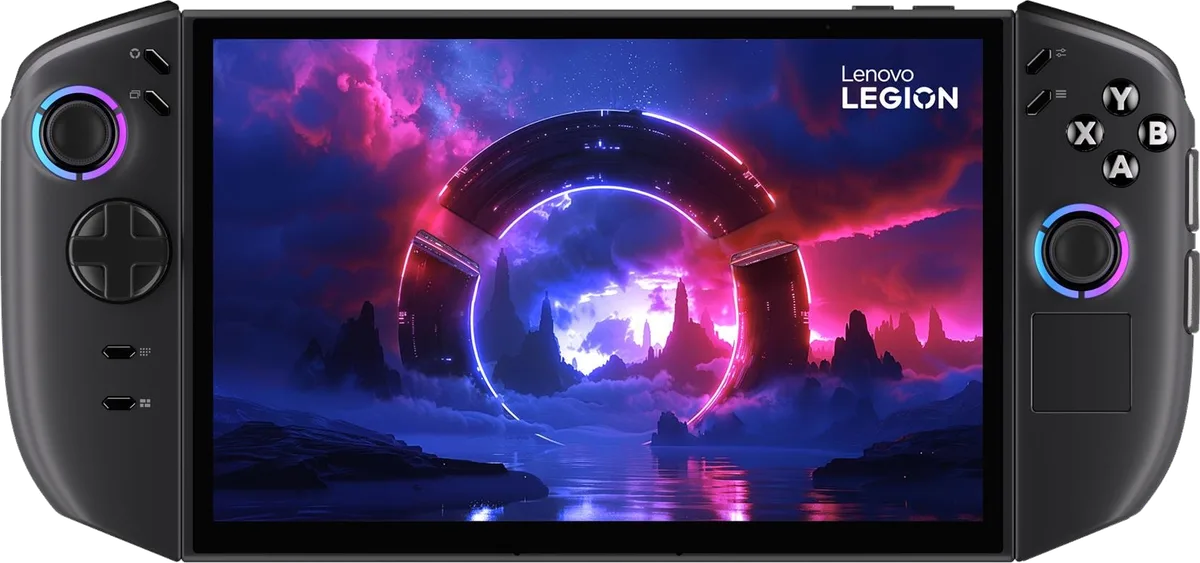
In the same reviews, Engadget measured the Claw 8 EX AI+ (Intel Arc G3 Extreme, 8-inch 1200p IPS) ahead of the Legion Go 2, and Tom's Hardware did in its Shadow of the Tomb Raider, Cyberpunk 2077 and Red Dead Redemption 2 results. The Go 2 has the OLED screen and detachable controllers. The Claw's reviews date from June to July 2026 and the Go 2's from September 2025 to February 2026, and Engadget's Claw numbers come from an engineering sample. In its June 2026 review Tom's Hardware put the Claw at $1,799 against $1,349.99 for the 32 GB Go 2.
We haven't tested these handhelds ourselves. This guide draws on published reviews, video tests and each device's sourced spec sheet.
Key differences
HandheldQuest calculation from the sourced specs below. Differences under 3% are left out.
- MSI Claw 8 EX AI+ has 8% more battery capacity (80 Wh vs 74 Wh)
- Lenovo Legion Go 2 is 135 g heavier than MSI Claw 8 EX AI+ (+17%, 920 g vs 785 g)
- Lenovo Legion Go 2 has a 10% larger screen (8.8″ vs 8″)
- Lenovo Legion Go 2 has a 20% higher refresh rate (144 Hz vs 120 Hz)
- MSI Claw 8 EX AI+ has 100% more base RAM (32 GB vs 16 GB)
- Lenovo Legion Go 2 has 100% more base storage (1 TB vs 512 GB)
- MSI Claw 8 EX AI+ lists for $120 more than Lenovo Legion Go 2 (+9%, $1,499 vs $1,379, lowest US list price)
Our take
Engadget measured the Claw ahead of the Legion Go 2 in the same review, and Tom's Hardware did in three games. In PC Gamer's gaming test its Endurance mode ran 308 minutes against 125 for the Ally X, though that mode gives up full-power frame rates; that is as far as the battery evidence goes. Those reviews are from June to July 2026, the Go 2 ones from late 2025 into early 2026, and Engadget tested an engineering sample, so I would read the size of the gap loosely.
The Legion Go 2 earns its place on the screen: Go 2 reviewers praised the OLED, and Tom's Hardware listed it $450 below the Claw in June 2026, though prices have moved since. The Claw suits someone who puts frame rate and runtime first and accepts an IPS panel and the premium. If the screen matters more than speed, the Go 2 is the one the reviews support.
Elvis
Pick the Claw 8 EX AI+ if
- You want the frame rates Engadget measured ahead of the Legion Go 2 and ROG Xbox Ally X
- You want a long Endurance-mode runtime: PC Gamer's PCMark gaming test ran 308 minutes against 125 for the Ally X, though Endurance mode does not deliver the full-power frame rates
- You prefer a lighter body at 785 g and Xbox-style flared grips
Pick the Legion Go 2 if
- You want an OLED screen, which Go 2 reviewers praised
- You want detachable controllers, a kickstand and FPS mode
- You want an 8.8-inch 144 Hz screen instead of 8 inches at 120 Hz
Key specs
| Spec | Claw 8 EX AI+ | Legion Go 2 |
|---|---|---|
| Chip | Intel Arc G3 Extreme | AMD Ryzen Z2 Extreme |
| Software | Windows 11 Home | Windows 11 Home |
| Screen size | 8″ | 8.8″ |
| Panel | IPS LCD | OLED |
| Resolution | 1920 × 1200 | 1920 × 1200 |
| Refresh rate | 120 Hz | 144 Hz |
| RAM | 32 GB | 16 GB / 32 GB |
| Storage | 512 GB / 1 TB | 1 TB |
| Battery | 80 Wh | 74 Wh |
| Weight | 785 g | 920 g |
| US list price | from $1,499 | from $1,379 |
Sources for every value are on each handheld's page. See every spec side by side.
What separates them
The chip, screen and controllers all differ. The Claw 8 EX AI+ uses Intel's Arc G3 Extreme with Arc B390 graphics, 32 GB of LPDDR5X, an 8-inch 1920x1200 IPS screen at 48 to 120 Hz and an 80 Wh battery. The Legion Go 2 uses the Ryzen Z2 Extreme, an 8.8-inch 1920x1200 OLED at 144 Hz and a 74 Wh battery, with detachable controllers. The Claw weighs about 785 g and the Go 2 about 920 g with the controllers on.
Performance: the Claw leads where reviews compared them
Engadget saw frame rate gains of 50 to 75 percent for the Claw over the ROG Xbox Ally X and the Legion Go 2. In Cyberpunk 2077 at 35 W, FHD, medium, XeSS performance it hit 95 fps against 62 and 57 fps for the two rivals. Engadget tested an Intel engineering sample with pre-production drivers.
Tom's Hardware measured a 20 to 30+ fps lead for the Claw over its peers, and sets the Claw against the Go 2 in its Shadow of the Tomb Raider, Cyberpunk 2077 and Red Dead Redemption 2 results. Notebookcheck's Claw review also puts Go 2 results in its benchmark tables. On the Go 2's own review, Tom's Hardware said the gains over current handhelds are biggest at 800p and an upgrade is not a must, and Tom's Guide found its maxed-out lab results only marginally above Z1 Extreme handhelds.
Upscaling support limits the lead. Tom's Guide counts only about 50 games with XeSS 3 support, and Windows Central saw DOOM: The Dark Ages fall below 30 fps on one level even with XeSS. Engadget adds that frame generation cannot be used in Endurance mode at launch.
Battery life
For the Go 2, Tom's Guide's PCMark 10 gaming test lasted 2 h 15 min, an hour less than the ROG Ally X, and Windows Central got 2 h 17 min in Cyberpunk 2077 on the Steam Deck preset at about 200 nits. Notebookcheck recorded about 2.5 hours in Performance mode and a little over five in Silent.
For the Claw, Notebookcheck measured Cyberpunk 2077 at 1080p Ultra and 150 nits for 1:39 at 35 W and 3:19 in Endurance mode. PC Gamer's PCMark gaming test went from two and a half hours to over five in Endurance mode, and Windows Central got around 3.5 hours in Endurance mode at 45% brightness, about 225 nits. The Go 2 figures above come from other outlets and workloads than these Claw figures, so compare the ranges, not single numbers.
Display: OLED against IPS
Every Go 2 review praised the 8.8-inch OLED, and several cover its VRR and HDR. Tom's Guide calls it arguably the best-looking handheld screen, and Notebookcheck measured 1,155 cd/m2 peak in HDR and just under 500 cd/m2 in SDR. Tom's Hardware measured 445 nits in SDR and PCWorld notes the glossy surface reflects in bright light.
Notebookcheck measured a maximum of about 540 nits and a contrast ratio near 1500:1 on the Claw and says it cannot match OLED rivals such as the Legion Go 2. Tom's Hardware calls the missing OLED a big miss at $1,799, while Engadget and Tom's Guide find the IPS panel more than good enough.
Comfort and controls
Tom's Hardware, Tom's Guide and PCWorld give the Go 2 as about 2.02 to 2.03 lb with the controllers attached, and Tom's Hardware would sometimes end sessions with tired hands and wrists. For the Claw, Windows Central and Tom's Hardware both give 785 g and say the grips spread it well.
Both use Hall effect sticks that should not drift. The Go 2 adds detachable controllers, a kickstand and an FPS mode, which Tom's Hardware rarely used and PCWorld did not find particularly ergonomic. On the Claw, Engadget finds the D-pad not ideal for fighting games and Tom's Hardware lists only two back buttons and no touchpad.
Heat, noise and software
Notebookcheck measured both. The Go 2 reached 39.7 dB(A) in the standard profile and 46 dB(A) in Manual mode. The Claw ran its fans constantly at 33.9 dB(A) at idle, 42.3 in AI Engine mode and 46.2 in Manual mode. PC Gamer found the Claw's fans quiet and PCWorld was impressed by how quiet the Go 2 stayed. (Notebookcheck)
Both run Windows 11 with a maker overlay. Tom's Hardware calls Legion Space the best Windows-masking software it has seen but had it freeze while remapping, and PCWorld, reviewing in autumn 2025, expected Microsoft's handheld mode to reach the Go 2 in spring 2026; none of the cited reviews says whether it did. The Claw ships with an Xbox full-screen mode and MSI Center M, but PC Gamer says Windows still feels unfinished next to SteamOS and Engadget describes juggling several launchers.
Price
In its June 2026 review Tom's Hardware lists the Claw at $1,799 and the OLED Legion Go 2 with 32 GB and 1 TB at $1,349.99, which is $450 less. Notebookcheck says the Claw's money could buy a gaming laptop with an RTX 5060. Engadget, PC Gamer and Windows Central tie the cost to memory and component prices.
Go 2 reviewers called their unit expensive too. Tom's Guide says even the base model costs more than the $999 ROG Xbox Ally X, and PCWorld notes $1,349 buys a $999 gaming laptop plus a $319 Steam Deck. Store prices have changed since these reviews and the Go 2's current list price in our data differs from the review-time figure, so check each device page before deciding.