Head to head
Nintendo Switch 2 vs ASUS ROG Xbox Ally X
By ElvisPublished
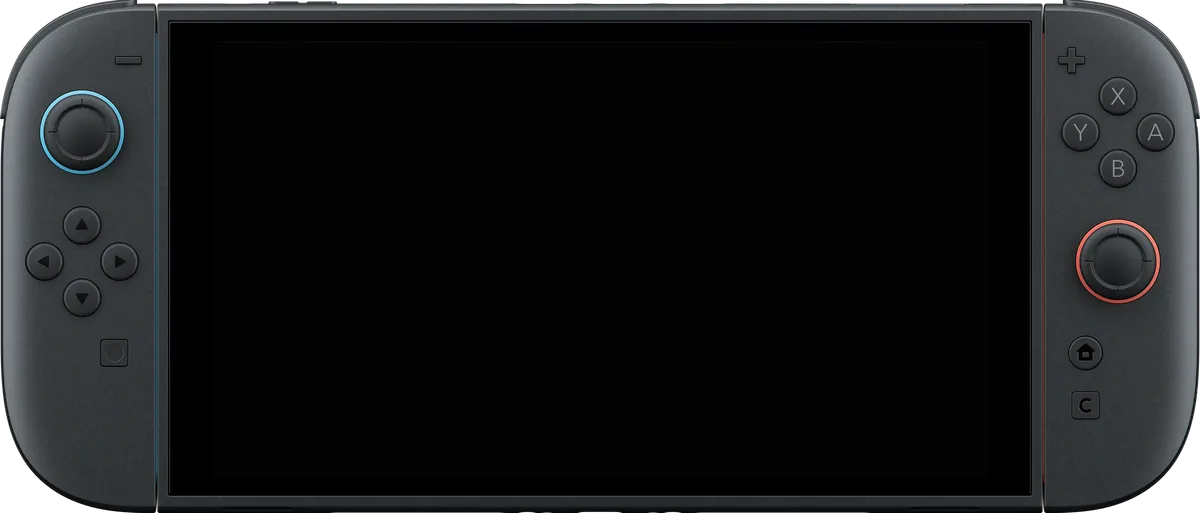
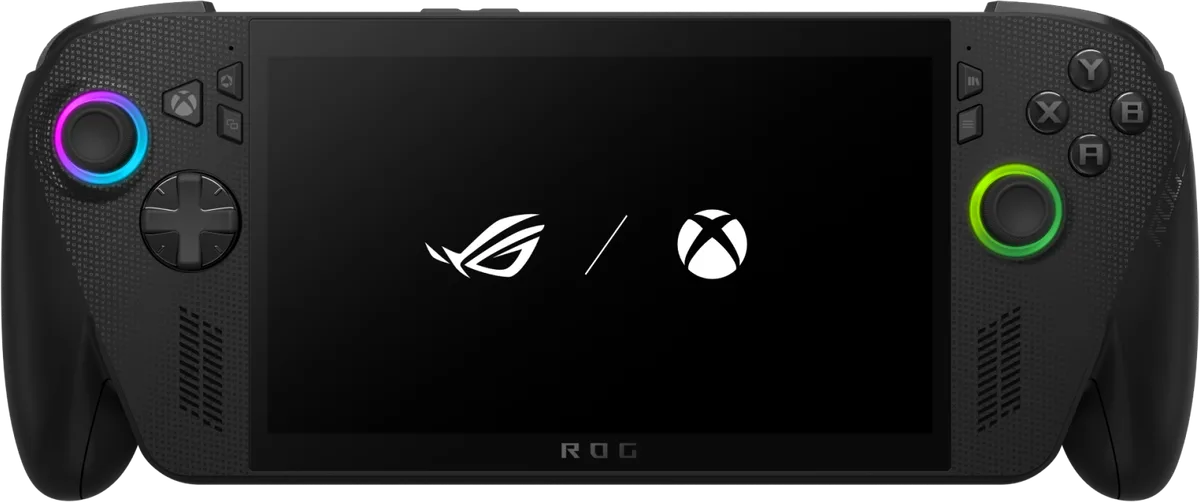
These are a console and a Windows PC in handheld form, so the first question is which games you want. The Switch 2 is the only place for Nintendo's games, costs half as much and has the bigger screen. The ROG Xbox Ally X runs your Steam, Epic and Game Pass libraries, loads games faster and showed better battery life in one video test at its lower power mode. In the one set of side-by-side tests we found, the gap in frame rate was smaller than the price gap suggests.
We haven't tested these handhelds ourselves. This guide draws on published reviews, video tests and each device's sourced spec sheet.
Key differences
HandheldQuest calculation from the sourced specs below. Differences under 3% are left out.
- ASUS ROG Xbox Ally X has 305% more battery capacity (80 Wh vs 19.74 Wh)
- ASUS ROG Xbox Ally X is 181 g heavier than Nintendo Switch 2 (+34%, 715 g vs 534 g)
- Nintendo Switch 2 has a 13% larger screen (7.9″ vs 7″)
- ASUS ROG Xbox Ally X has 100% more base RAM (24 GB vs 12 GB)
- ASUS ROG Xbox Ally X has 300% more base storage (1 TB vs 256 GB)
- ASUS ROG Xbox Ally X lists for $500 more than Nintendo Switch 2 (+100%, $999.99 vs $499.99, lowest US list price)
Our take
If your list has Mario Kart, Zelda or Pokemon on it, the choice is made: the Ally X cannot run them. If it is mostly PC games, the choice is just as clear, because the Switch 2 cannot run your Steam library and the Ally X can. The overlap is the third-party AAA ports, and that is where the one head-to-head we found is useful.
That test, a video by ElAnalistaDeBits written up by Notebookcheck, Wccftech and Pocket Tactics, found the Switch 2 close to the Ally X in the games tested, with cleaner upscaling thanks to DLSS, at under half the price. Treat it as early evidence: it is a single video from the first days of the Ally X, and we did not find a second outlet that ran both consoles through the same games. The Ally X's other advantages: a much larger library via the Windows storefronts, faster loads in that video, and comfortable grips in its reviews. Its drawbacks are the $999.99 price, 715 g of weight and a Windows layer that reviewers say is still rough in places.
Elvis
Pick the Switch 2 if
- You want Nintendo's own games, which only run on Nintendo hardware
- You want the larger 7.9-inch screen and a console that also plays on the TV, at about half the price
- You want a pick-up-and-play device with no launchers or settings to manage
Pick the ROG Xbox Ally X if
- You have a Steam, Epic or Game Pass library you want to play on the go
- You want faster game loading and the longer battery life one video test showed at the 17 W mode
- You play for hours at a time and want proper grips, and can accept the price and the weight
Key specs
| Spec | Switch 2 | ROG Xbox Ally X |
|---|---|---|
| Chip | NVIDIA T239 (custom) | AMD Ryzen AI Z2 Extreme |
| Software | Nintendo Switch 2 system software | Windows 11 Home |
| Screen size | 7.9″ | 7″ |
| Panel | LCD | IPS LCD |
| Resolution | 1920 × 1080 | 1920 × 1080 |
| Refresh rate | 120 Hz | 120 Hz |
| RAM | 12 GB | 24 GB |
| Storage | 256 GB | 1 TB |
| Battery | 19.74 Wh | 80 Wh |
| Weight | 534 g | 715 g |
| US list price | from $499.99 | from $999.99 |
Sources for every value are on each handheld's page. See every spec side by side.
What each one is, and what the evidence covers
The Switch 2 is Nintendo's console with an NVIDIA custom chip, 12 GB of RAM, a 7.9-inch 1080p 120 Hz screen and 256 GB of storage. The ROG Xbox Ally X is a Windows 11 handheld with a Ryzen AI Z2 Extreme, 24 GB of RAM, a 7-inch 1080p 120 Hz IPS screen, an 80 Wh battery and 1 TB of storage.
We found no outlet that reviewed the two together in a full head-to-head. What exists is one YouTube comparison by ElAnalistaDeBits from mid-October 2025, which Notebookcheck, Wccftech and Pocket Tactics wrote up. The rest of this page puts that test beside what each device's reviewers found separately, so the figures below are from different tests unless a paragraph says otherwise.
Games and software
Nintendo's first-party games run only on the Switch 2. PC Gamer likes its clean interface that needs no tuning. IGN and PC Gamer add that the launch library was thin and that Windows handhelds and the Steam Deck offer a larger catalogue of cheaper games.
The Ally X runs Windows 11 with an Xbox full-screen mode. Tom's Hardware calls that mode much better than plain Windows 11 but not as polished as SteamOS, and lists launcher quirks, including Epic needing touch input. TechRadar was disappointed that Windows still shows through during updates and problems. Tom's Guide and Tom's Hardware warn that Xbox Play Anywhere does not cover every game.
Notebookcheck's write-up of the video says Windows 11 and Steam give the Ally X a larger library than the Switch 2, and that its Xbox interface is less simple than a console's. Pocket Tactics says the Ally X was seconds slower to start up, though Wccftech's timings put power-on at 13.1 s against 14 s and show the gap mainly in restarts. Pocket Tactics argues that Cyberpunk 2077 and Star Wars Outlaws were optimised for the Switch 2, so they run well without settings changes.
Performance and image quality
The one side-by-side test is the ElAnalistaDeBits video. In Hogwarts Legacy, per Wccftech, the Switch 2 held its 30 fps cap while the Ally X went past 40 fps in Turbo mode and only just above 30 fps in Performance mode. In Star Wars Outlaws, the Ally X needed FSR in Performance mode and frame generation to reach about 30 fps at low settings. Wccftech sums it up as a clear Ally X advantage, but smaller than expected, and Notebookcheck calls the Hogwarts Legacy difference minimal.
Image quality favoured the Switch 2 in that video. Wccftech reports it used a dynamic 635p resolution with DLSS in Star Wars Outlaws, which looked cleaner than the Ally X's fixed 635p, especially for distant detail. Notebookcheck describes both handhelds upscaling from 635p to 1080p in an open-world Ubisoft game, with the Ally X looking softer under FSR, especially in distant textures. The two write-ups differ on whether the Switch 2's 635p was dynamic.
Reviewers of each device agree on the wider picture. PC Gamer says the Switch 2 chip is outpaced by the Ryzen Z1 Extreme in the ROG Ally, and Tom's Guide says the best portable versions of Cyberpunk 2077 and Hogwarts Legacy are on the Switch 2. Notebookcheck measured the Ally X as the fastest Ryzen handheld chip it had tested at the time, with 14 percent higher results than the 2024 Ally X, and GamesRadar+ measured a 54 fps average in Cyberpunk 2077 at 1080p in 25 W Turbo mode. Those Cyberpunk figures are for the Ally X only, and no outlet gave a matching Switch 2 number.
Screen
Both screens are 1080p at 120 Hz with variable refresh, and the Switch 2's is larger at 7.9 inches against 7. Reviewers describe both as good for gaming. Tom's Guide called the Switch 2 panel gorgeous, while Engadget measured around 400 nits and found blacks closer to gray than on an OLED.
For the Ally X, Tom's Guide measured 515.8 nits and 77.9 percent DCI-P3 and was disappointed to find no OLED at the price, and Tom's Hardware notes there is no HDR support. No outlet we cite compared the two panels side by side, so which looks better in a given room is unknown.
Battery life
The video gives the only matched runtimes, via Wccftech's table. In Cyberpunk 2077 the Switch 2 lasted 2:07, the Ally X 1:59 in 25 W Turbo mode and 3:03 in 17 W Performance mode. In Hollow Knight: Silksong the Switch 2 lasted 3:30, and the Ally X 4:38 in either mode. The Switch 2's settings were not stated, and this is a single run per game.
The separate reviews point the same way. Engadget measured 2:23 in Mario Kart World on the Switch 2, and Tom's Guide and IGN put its demanding games at around two and a half hours. For the Ally X, Notebookcheck recorded 2 h 13 min in Turbo mode and 3 h 12 min in Performance mode, and Windows Central logged 1 h 53 min in Cyberpunk 2077 at 25 W.
Comfort, size and loading
The Ally X has permanently attached grips that every reviewer praised: Tom's Guide called it the most comfortable handheld it had used. The cost is bulk, since Tom's Hardware and Notebookcheck both call it wider and bulkier for travel. The data sheet lists 715 g against 534 g for the Switch 2.
The Switch 2 is the opposite. Tom's Guide, IGN and GamesRadar+ say its flat body gets uncomfortable in long handheld sessions compared with a Steam Deck or ROG Ally, and everyone liked the magnetic Joy-Con. IGN lists docked output of 4K with HDR, or up to 120 fps at 1440p in supported games.
Loading favours the Ally X in the video. Wccftech lists Cyberpunk 2077 at 27 seconds on the Switch 2 against 10 seconds on the Ally X, Hogwarts Legacy at 15 against 10, and Star Wars Outlaws at 17 against 13. The Switch 2 restarted faster, at 18 seconds against about 31.
Price
Our device data, checked on 2026-11-05, lists the Switch 2 at $499.99 and the Ally X at $999.99 in the US, a gap of $500. The video write-ups were published when the Switch 2 cost $449.99. Tom's Hardware called the Ally X price a big jump from the 2024 model's $799, and Tom's Guide said only serious gamers with large PC libraries should pay it. Notebookcheck's write-up of the video concluded that the Switch 2 was the more appealing buy unless the freedom of a Windows handheld is worth the extra money.
The Switch 2 had a $449.99 launch price, so the reviewers' value verdicts on it were written against that figure. Engadget said it is worth buying and IGN called the 50 percent premium over the original a catch-up. PC Gamer pointed out that a Steam Deck and similarly priced Windows handhelds offer more performance and a bigger library of cheaper games.