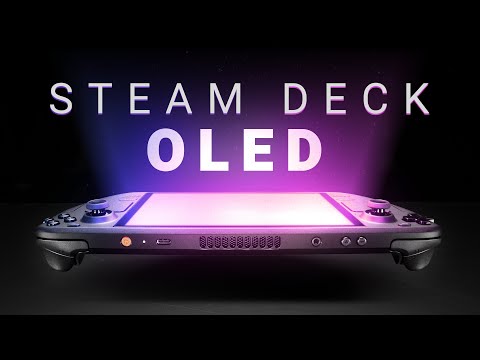
Review consensus
Valve Steam Deck OLED: what the reviews agree on
By ElvisPublished
Reviewers call the Steam Deck OLED the version of Valve's handheld to buy. The HDR OLED screen, longer battery life, cooler running and lighter build all get praise. Performance is the same as the LCD model, though, so demanding new games still need tuned settings, and handhelds with a Ryzen Z1 Extreme or newer chip run them faster.
We haven't tested the Steam Deck OLED ourselves. This page pulls together what published reviews and video tests found, with each outlet linked where it's mentioned.
Our take
If your games live on Steam, this is still the handheld I'd point most people to. The OLED panel is the upgrade reviewers keep coming back to, battery life is clearly better than on the LCD model, and SteamOS asks far less of you than Windows does on any rival.
Its limit is the chip. Performance is the same as on the LCD model, so new AAA releases mean 30 to 45 fps and some settings work, and games with kernel anti-cheat are off the table. If those two things matter more to you than the screen and the simplicity, look at a Ryzen Z2 Extreme handheld instead.
Elvis
Good fit if
- Playing a large Steam library on the go with the least setup
- Indie and older AAA games, where battery life stretches to five hours or more
- First-time buyers choosing between Steam Deck models
Look elsewhere if
- You want higher frame rates in new AAA games
- You mainly play games with kernel anti-cheat or games outside Steam
- You already own an LCD Steam Deck and only play occasionally
Performance
Every review measured the same frame rates as the LCD Steam Deck. Older and lighter games run well. Recent AAA games often sit at 30 to 45 fps and may need settings changes, even when Steam marks them Verified.
- In IGN's tests every game landed within 3 fps of the original Deck. GamesRadar+ measured near-identical Cyberpunk 2077 results, with the OLED about 4 fps ahead in Hitman 3.
- Tom's Guide saw Doom Eternal and Marvel's Spider-Man at 35 to 45 fps on medium settings, and Cyberpunk 2077 holding 30 fps on its Steam Deck preset.
- TechRadar had Control at 60 fps on medium and Hades 2 near 60 fps. Some Deck Verified games ran poorly at default settings, such as Deathloop at about 15 fps and Detroit: Become Human dipping to the 15 fps range.
- GamesRadar+, IGN and TechRadar all point out that Windows handhelds with the Ryzen Z1 Extreme, such as the ROG Ally, post higher frame rates, but they cost more.
Battery life
All reviewers measured clearly longer play than on the LCD model. They split on whether that is enough: about two to two and a half hours in demanding 3D games is still short for a long trip.
- Playing Cyberpunk 2077 at 50% brightness, IGN got just over 90 minutes from the LCD model and a full hour more from the OLED, about 66% longer.
- Tom's Guide played Spider-Man on medium for a little over two hours, against about 90 minutes on its original Deck.
- GamesRadar+ played for almost four hours without capping frame rate or refresh rate, against just under three hours on its LCD unit.
- At default settings PC Gamer got 45 to 60 minutes more than the original. Keeping HDR on at 90 Hz cost only about 20 minutes.
- TechRadar got just over two hours in demanding games at middle brightness and over five hours in Hades 2, and still counted battery life among the main weaknesses.
Display
The 7.4-inch HDR OLED is the headline upgrade in every review. Reviewers praise its brightness, contrast, colour and 90 Hz refresh rate. The resolution is still 1280x800.
- Tom's Guide measured 597 nits in SDR and 969 nits with HDR content, against 169 nits on the original Deck, with 101.8% DCI-P3 coverage and a Delta-E of 0.22.
- IGN notes that SDR brightness tops out around 600 nits; the 1,000-nit peak applies to HDR content.
- PC Gamer and GamesRadar+ say the 90 Hz refresh rate makes games running at 30 to 45 fps feel smoother and menus more responsive.
- PC Gamer points out that the resolution is still 1280x800, and says the contrast and colour help hide the softness.
Comfort & controls
Reviewers like the grips, the controls and the redesigned, more concave thumbsticks. They also noticed the roughly 30 g weight cut. The size gets criticism: the Deck is still big and hard to carry.
- The weight drop of about 29 to 30 g was noticeable in long sessions for PC Gamer, GamesRadar+ and IGN.
- Tom's Guide, PC Gamer and GamesRadar+ found the new concave thumbsticks grip better than the slippery originals.
- TechRadar found the 298 mm body hard to pack alongside a laptop. Game Informer dislikes the high placement of the thumbsticks.
Heat & noise
Reviewers agree the OLED model runs cooler and quieter than the LCD model, thanks to the more efficient chip and a larger fan.
- IGN's side-by-side thermal tests show hotspots near the vents 5 to 10 °C cooler, with less heat spread across the body.
- GamesRadar+ saw about 60 °C under load and says the fan rarely drew attention. PC Gamer describes the larger fan as much softer than before.
- Tom's Guide and Game Informer found the vents and body noticeably less hot than on the original.
Software
SteamOS is described as easier to use than Windows on rival handhelds. Its Linux base still brings limits: games outside Steam need workarounds, and some anti-cheat games do not run at all.
- GamesRadar+ and IGN rate SteamOS as easier to use than Windows 11 on rival handhelds.
- IGN notes that Epic, GOG and itch.io games usually need desktop mode and third-party launchers. Games with Easy Anti-Cheat such as Fortnite, and Call of Duty: Warzone, do not run on SteamOS.
- TechRadar found the Deck Verified badge an unreliable guide to how well a game runs out of the box.
Value
For new buyers, reviewers call it strong value, with more storage than before at a similar price. For LCD owners the upgrade is optional, because the games run the same.
- The OLED launched at $549 for 512 GB and $649 for 1 TB, and the 256 GB LCD model dropped to $399. IGN and PC Gamer note that storage roughly doubled for about the same money.
- Tom's Guide and PC Gamer advise current owners who play only occasionally to keep their LCD model. Game Informer calls the OLED a considerable expense for an incremental change.
Video reviews