Head to head
Nintendo Switch 2 vs Nintendo Switch – OLED Model
By ElvisPublished
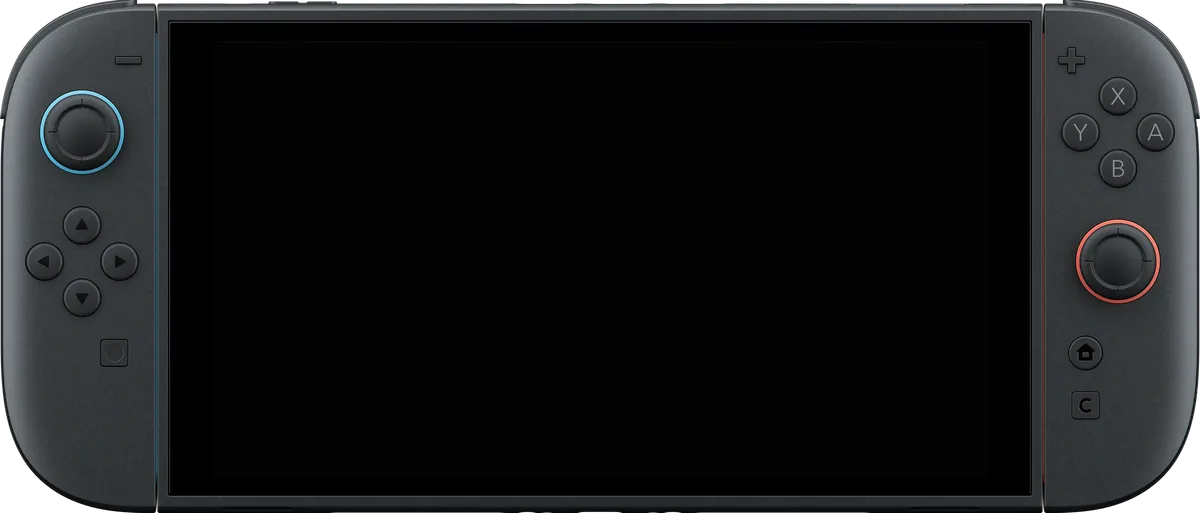
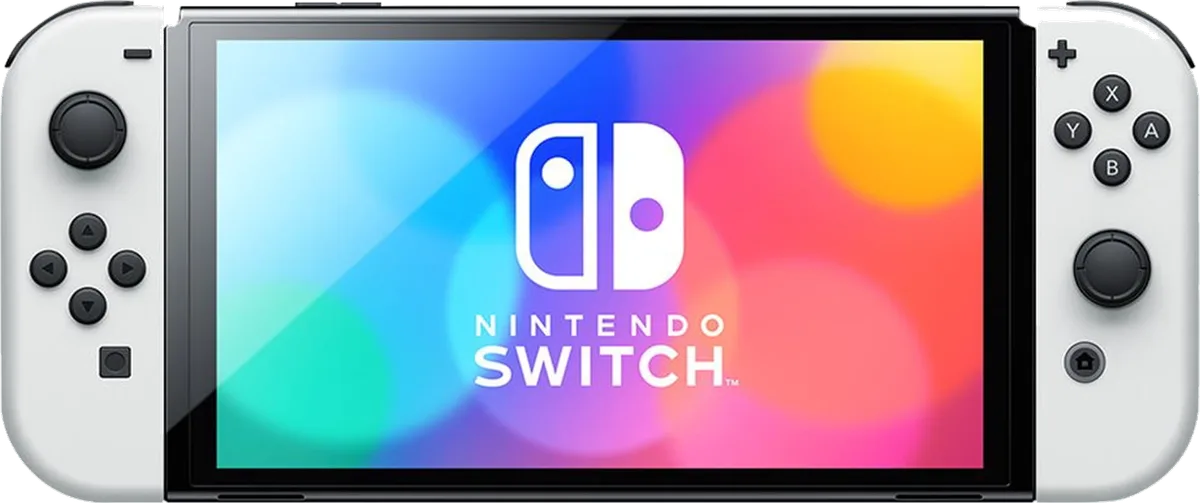
For a Switch OLED owner the Switch 2 is a real upgrade in speed, resolution, size and library, and the only upgrade that buys you new Nintendo games. The OLED holds two advantages in the reviews: deeper contrast on its panel and a higher rated battery life. If you mostly replay your existing library, the case for moving is weaker, and the OLED is still the cheaper console. Decide by whether you want Switch 2 games and 1080p handheld play.
We haven't tested these handhelds ourselves. This guide draws on published reviews, video tests and each device's sourced spec sheet.
Key differences
HandheldQuest calculation from the sourced specs below. Differences under 3% are left out.
- Nintendo Switch 2 is 114 g heavier than Nintendo Switch – OLED Model (+27%, 534 g vs 420 g)
- Nintendo Switch 2 has a 13% larger screen (7.9″ vs 7″)
- Nintendo Switch 2 has 125% more screen pixels (1920 × 1080 vs 1280 × 720)
- Nintendo Switch 2 has 300% more base storage (256 GB vs 64 GB)
- Nintendo Switch 2 lists for $100 more than Nintendo Switch – OLED Model (+25%, $499.99 vs $399.99, lowest US list price)
Our take
If you own a Switch OLED, the reviews we cite agree the Switch 2 is the stronger console. The deciding question is whether you will play games that need it. Switch 2 exclusives only run there, and third-party ports such as Cyberpunk 2077 are the ones reviewers praised on it. If either is on your list, move.
If your plan is to finish the backlog on your OLED, there is no urgency. The OLED screen still has the better blacks, the battery rating is higher, and your microSD cards keep working. One catch from the sources is worth knowing: some Switch 1 games still run at 720p in handheld mode on the Switch 2, so a game that looked sharp on the OLED's smaller panel is not guaranteed to look better on the new one. We could not find a head-to-head battery test of the two in the same game, so the battery gap rests on ratings and separate tests.
Elvis
Pick the Switch 2 if
- You want Switch 2 games, which the OLED cannot run
- You want the larger 1080p 120 Hz handheld screen and faster performance in third-party ports
- You play docked as much as handheld and want a bigger step on the TV
Pick the Switch OLED if
- You mostly play your existing Switch library and want to spend nothing
- You value OLED contrast and the longer rated battery life
- You own microSD cards and accessories you want to keep using
Key specs
| Spec | Switch 2 | Switch OLED |
|---|---|---|
| Chip | NVIDIA T239 (custom) | NVIDIA custom Tegra processor |
| Software | Nintendo Switch 2 system software | Nintendo Switch system software |
| Screen size | 7.9″ | 7″ |
| Panel | LCD | OLED |
| Resolution | 1920 × 1080 | 1280 × 720 |
| Refresh rate | 120 Hz | — |
| RAM | 12 GB | — |
| Storage | 256 GB | 64 GB |
| Battery | 19.74 Wh | — |
| Weight | 534 g | 420 g |
| US list price | from $499.99 | from $399.99 |
Sources for every value are on each handheld's page. See every spec side by side.
Games: what the Switch 2 adds
The OLED plays no Switch 2 games, and that is the main reason to move. GamesRadar+ says the Switch 2 plays pretty much everything the OLED can plus its own catalogue, with a few original Switch games it cannot run and some that need old Joy-Con. TechRadar, writing after two weeks of swapping its Switch OLED for a Switch 2, called backwards compatibility exceptional and almost complete.
Existing games can get better too. TechRadar names Pokemon Scarlet and Violet and Super Mario 3D World + Bowser's Fury as games whose updates improve image quality and frame rate, and says Super Mario Odyssey and two Zelda games gained HDR support. GamesRadar+ adds one caveat: in its testing the free updates did not lift Switch 1 games to 1080p in handheld mode, so they stay at 720p on the bigger screen even when they support 1080p docked. (GamesRadar+)
GamesRadar+ makes the opposite case for the OLED. It recommends the older console to players who only want to catch up on original Switch games and not pay for a new one, and says the OLED keeps your existing SD cards usable. (GamesRadar+)
Performance
The OLED has the same processor as the 2017 Switch. Engadget found the CPU and GPU unaltered, and GamesRadar+ expected no difference in loading times or frame-rate stability. Tom's Guide listed a Tegra X1, 4 GB of RAM, up to 720p at 60 fps in handheld mode and up to 1080p at 60 fps docked.
The Switch 2 is a different class. Our device data lists 12 GB of RAM, and GamesRadar+ says it loads faster and renders further into the distance at higher resolution. Tom's Guide calls the best portable versions of Cyberpunk 2077 and Hogwarts Legacy the ones on Switch 2, and PC Gamer says the chip is still outpaced by the Ryzen Z1 Extreme in the ROG Ally. Tom's Guide adds that it cannot outmuscle a PS5.
Screen: bigger and sharper against deeper blacks
The Switch 2 has a 7.9-inch 1080p LCD at up to 120 Hz with VRR, against a 7-inch 720p OLED at 60 Hz. GamesRadar+ calls the sharpness difference pretty much night and day in Mario Kart World, and says the larger screen feels more immersive. TechRadar singles out the 1080p panel as the biggest improvement.
The OLED still wins on contrast. GamesRadar+ says you lose the dark, inky blacks, and Engadget found the Switch 2's blacks closer to gray in dark scenes, with around 400 nits at full brightness. PC Gamer finds the panel less lush than the OLED model and the handheld HDR mediocre, while TechRadar says HDR10 goes a long way to make up the contrast.
Outdoors, GamesRadar+ found the OLED struggled in direct daylight in its 2021 review, and its 2025 comparison table lists about 400 nits for the Switch 2 against roughly 350 for the OLED. No source we cite tested the two side by side in sunlight, so which is easier to read outdoors is unknown. (GamesRadar+)
Battery life
Nintendo's ratings favour the OLED: 4.5 to 9 hours against 2 to 6.5 hours for the Switch 2, as GamesRadar+ lists them. GamesRadar+ says the OLED panel is far more efficient, and that on demanding games the older console more than doubles the Switch 2's minimum runtime.
Reviews of each console used different games. On the OLED, Engadget got almost seven hours of Metroid Dread, while Tom's Guide got about 5 hours of the same game. On the Switch 2, Engadget measured 2:23 in Mario Kart World and GamesRadar+ about 2 h 40 min in Breath of the Wild at full brightness. These are not like-for-like, but the direction matches the ratings.
Comfort, controls and storage
Our data lists 534 g for the Switch 2 and 420 g for the OLED, both with the Joy-Con attached. GamesRadar+ found the extra weight did not strain its hands, but says the OLED's shorter body makes the small buttons easier to reach, and that neither console has the grips of a Steam Deck. It prefers the Switch 2's matte finish.
The Switch 2 Joy-Con attach by magnet and add a mouse sensor, which GamesRadar+ liked in Metroid Prime 4: Beyond, and the console has a second USB-C port. The OLED keeps rail-attached Joy-Con. Storage differs as well: 256 GB against 64 GB, but the Switch 2 needs the pricier microSD Express cards and cannot use the cheaper cards the OLED takes, GamesRadar+ notes.
Price and the upgrade decision
The Switch OLED launched at $349.99 and now lists at $399.99 in the US. The Switch 2 launched at $449.99 and now lists at $499.99, so the gap has stayed at $100 since launch. GamesRadar+ judged the extra $100 well spent for the best performance and display, but said the OLED holds up for catching up on older games at a lower price.
GamesRadar+ wrote its upgrade advice in June 2025, before many Switch 2 games existed, and its two pieces are the buying advice this page leans on. Its guide said to buy the Switch 2 for the latest games, third-party games and more precise controls, and the OLED if you want to spend less, catch up on the library or put battery life first. Our Switch 2 and Switch OLED consensus pages hold each device's reviewers' full findings. (GamesRadar+)