Head to head
ASUS ROG Xbox Ally vs ASUS ROG Xbox Ally X
By ElvisPublished
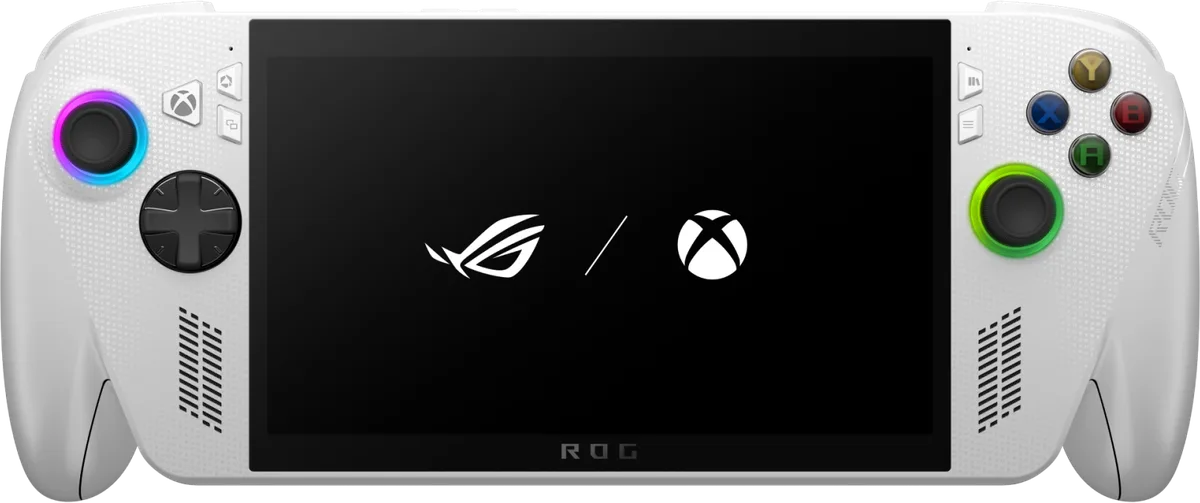
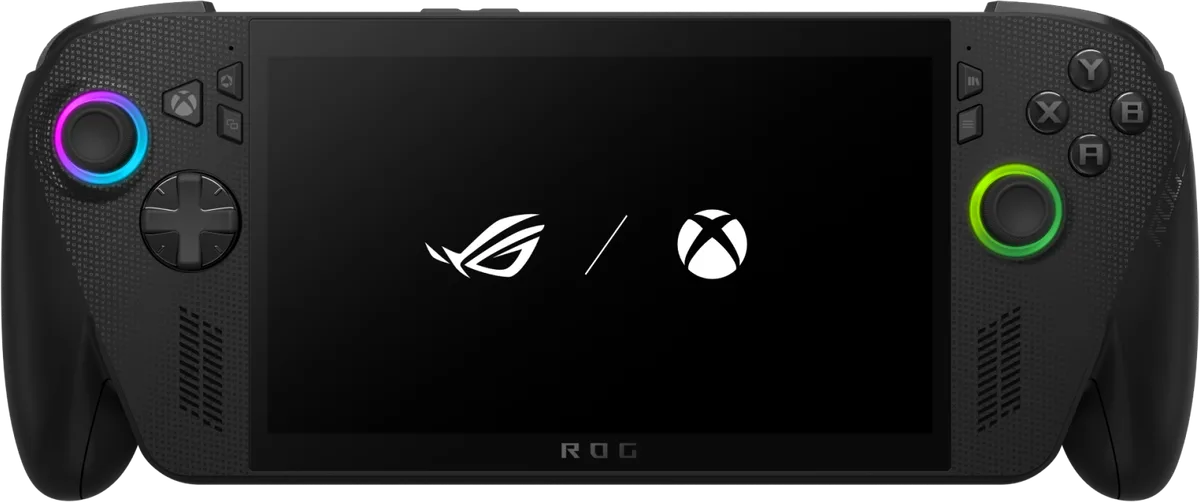
Buy the $999.99 Ally X for recent AAA games; the $599.99 Ally, a Steam Deck-class chip in the same body, suits indie, older and streamed games. Both share the grips, screen specs and Xbox full-screen interface. The Ally X adds the Ryzen AI Z2 Extreme, 24 GB of LPDDR5X, 1 TB, a USB4 port and an 80 Wh battery, while the Ally's Ryzen Z2 A usually needs 720p and lowered settings in demanding recent games.
We haven't tested these handhelds ourselves. This guide draws on published reviews, video tests and each device's sourced spec sheet.
Key differences
HandheldQuest calculation from the sourced specs below. Differences under 3% are left out.
- ASUS ROG Xbox Ally X has 33% more battery capacity (80 Wh vs 60 Wh)
- ASUS ROG Xbox Ally X is 45 g heavier than ASUS ROG Xbox Ally (+7%, 715 g vs 670 g)
- ASUS ROG Xbox Ally X has 50% more base RAM (24 GB vs 16 GB)
- ASUS ROG Xbox Ally X has 100% more base storage (1 TB vs 512 GB)
- ASUS ROG Xbox Ally X lists for $400 more than ASUS ROG Xbox Ally (+67%, $999.99 vs $599.99, lowest US list price)
Our take
The two look and feel alike, and Tom's Guide called each of them the most comfortable handheld it had used. Windows Central reviewed both and ranks the Ally X among its best Windows handheld results and the Ally near its worst.
If your library is mostly indie games, older titles and cloud streaming, I'd save the $400 and buy the Ally. Tom's Guide and Notebookcheck both thought its price was too high for that level of speed, so weigh a Steam Deck too. If you want recent AAA games to run decently, the Ally X is the one to buy, even though reviewers also call it expensive.
Elvis
Pick the ROG Xbox Ally if
- You mostly play indie, 2D and older games or stream from the cloud
- You want the Xbox Ally grips and interface for $400 less
- You want long runtimes in light games at low power
Pick the ROG Xbox Ally X if
- You want recent AAA games playable at 1080p with tuning
- You want 24 GB of memory, 1 TB of storage and a USB4 port
- You want the Xbox Ally design with the faster chip of the pair
Key specs
| Spec | ROG Xbox Ally | ROG Xbox Ally X |
|---|---|---|
| Chip | AMD Ryzen Z2 A | AMD Ryzen AI Z2 Extreme |
| Software | Windows 11 Home | Windows 11 Home |
| Screen size | 7″ | 7″ |
| Panel | IPS LCD | IPS LCD |
| Resolution | 1920 × 1080 | 1920 × 1080 |
| Refresh rate | 120 Hz | 120 Hz |
| RAM | 16 GB | 24 GB |
| Storage | 512 GB | 1 TB |
| Battery | 60 Wh | 80 Wh |
| Weight | 670 g | 715 g |
| US list price | from $599.99 | from $999.99 |
Sources for every value are on each handheld's page. See every spec side by side.
Price and what the extra $400 buys
Both launched on 16 October 2025. ASUS lists the ROG Xbox Ally at $599.99 with 16 GB and 512 GB, and the ROG Xbox Ally X at $999.99 with 24 GB and 1 TB. Those are launch list prices; current street prices are unknown here, so check the device pages.
Both measure 290 x 121 x 50.9 mm, carry a 7-inch 1920x1080 IPS touchscreen at 120 Hz with FreeSync Premium, and come with Wi-Fi 6E, Bluetooth 5.4, 65 W charging, a UHS-II microSD reader and Windows 11 Home. The Ally X is 45 g heavier at 715 g against 670 g.
The chips and memory are where they split. The Ally runs the Ryzen Z2 A with 4 cores, 8 threads and 8 GPU compute units, paired with 16 GB at 6400 MT/s. The Ally X has the Ryzen AI Z2 Extreme with 8 cores, 16 threads and 16 compute units, and 24 GB of LPDDR5X. AMD gives the Z2 A a configurable range of 6 to 20 W and the Z2 Extreme 15 to 35 W. The Ally has two USB 3.2 Gen 2 Type-C ports; the Ally X makes one of them USB4, and its battery is 80 Wh instead of 60 Wh.
Windows Central's pre-launch buying guide drew the same line, pointing performance seekers to the Ally X and budget buyers to the Ally. It noted the Ally X's 33% larger battery capacity and its NPU, and said it could not yet test the performance gap. That test is below, from the reviews that followed.
Performance: Steam Deck class against the stronger chip
Every review of the base model treats the Z2 A, with its four Zen 2 cores and RDNA 2 graphics, as Steam Deck-class hardware. In Notebookcheck's suite at the 24/20 W Turbo setting it was the slowest device in most games, behind the Steam Deck OLED by a small margin and clearly behind the original ROG Ally. Tom's Hardware found nothing in its test games playable at 1080p.
In Windows Central's benchmark tables, which cover both, the Ally sits at or next to the bottom every time, while the Ally X posts some of the best Windows handheld numbers the site had logged. The Ally's Z2 A also ranks last of all handhelds in its Cinebench R24 run. It adds that AMD's HYPR-RX tuning, which lifts the Ally X, is not offered on the Ally.
Windows Central ran Cyberpunk 2077 on its Steam Deck preset on both. The Ally, plugged in at 20 W Turbo at 1080p with FSR 2.1 on Auto, averaged 27.32 fps. Its Ally X review gives about 45 fps on that preset without naming a power mode, and 83.61 fps in a run at 35 W Turbo on the charger with HYPR-RX defaults on, so the two Ally X figures come from different setups. Trusted Reviews needed 720p for the Ally to pass 30 fps on that preset. GamesRadar+ had the Ally X at 54 fps in Cyberpunk at native 1080p, 25 W Turbo. (Windows Central)
Neither runs recent AAA games at high settings without help. On the Ally, Tom's Hardware got Resident Evil Requiem to 32 to 55 fps at 720p low without upscaling, and Tom's Guide saw about 40 fps in Forza Horizon 5 and Halo Infinite at 720p low. On the Ally X, reviewers still lowered settings or turned to upscaling and frame generation in demanding games: GamesRadar+ reached 99 fps in Cyberpunk 2077 only with both switched on.
TechRadar's Isaiah Williams argues in an October 2025 opinion piece that neither model is worth buying. For the Ally X he says the Z2 Extreme does better than a Ryzen Z1 Extreme handheld at lower power limits but gains only single-digit frame rates at higher ones; for the Ally he points to the Steam Deck's similar four-core chip at a lower price. The piece rests on benchmarks seen before launch, not on a review of both.
Battery: a smaller pack, similar runtimes
The Ally has a 60 Wh battery and the Ally X an 80 Wh one, but the lower-power chip closes most of the gap in games. Notebookcheck rates the two roughly on par: the Ally ran about 2 hours in Turbo mode and just under 3 in Performance mode, the Ally X 2 h 13 min and 3 h 12 min. Silent mode ran almost 10 hours on the Ally and about 4 on the Ally X, but that mode is 6 W on the Ally and 13 W on the Ally X. Turbo is 20 W against 25 W, so the modes are not identical. (Notebookcheck)
Windows Central's Cyberpunk 2077 runs on the Steam Deck preset lasted 1 h 48 min on the Ally at 20 W and about 200 nits, and 1 h 53 min on the Ally X at 25 W and 60% brightness, so the settings are close but not identical. In Celeste at 25% brightness, the Ally ran 7 h 6 min in its 6 W Silent mode and the Ally X 5 h 6 min at 13 W. (Windows Central)
Other single-device results fit that picture. Trusted Reviews got 2 h 20 min from the Ally in PCMark 10 Gaming and 9 h 11 min in its Modern Office test at 150 nits. TechRadar's PCMark 10 gaming run on the Ally X lasted just under three hours, and GamesRadar+ played Silent Hill f for 2.5 hours in Turbo mode at half brightness.
Screen: the same specs, the same limits
ASUS rates both panels at 500 nits. Tom's Hardware measured 488.8 nits on the Ally and reports 515.8 nits on the Ally X, and Notebookcheck put the Ally X's peak at 490 nits. Notebookcheck also lists the Ally's brightness falling short of the advertised figure among its cons. (Tom's Hardware)
Reviewers judge the panel the same way on both: sharp, smooth and good for gaming, but not an OLED. Tom's Hardware found the Steam Deck OLED's screen far more vivid than the Ally's, Tom's Guide was let down to see no OLED on a $999.99 Ally X, and Tom's Hardware notes the Ally X panel has no HDR support.
Comfort and controls
Reviewers praise the grips on both. Tom's Guide named each the most comfortable handheld it had used, and Windows Central says the Ally is the only handheld its reviewer could hold without the little fingers going numb. The 45 g difference is the main physical change, and Notebookcheck found the Ally X's weight no problem. (Tom's Guide)
The complaints overlap too. Tom's Hardware found the bumpers cheap on both, and Windows Central had the fingerprint reader fail now and then on both. Notebookcheck lists the bulky grips as a con on the Ally, and Tom's Hardware and Notebookcheck both say the Ally X's grips make it wider and bulkier to pack for travel. (Windows Central)
Tom's Hardware spotted one control difference: the Ally's triggers have no rumble, while the Ally X has impulse triggers, though it found their vibration weak. Both spec sheets list Hall effect triggers and HD haptics. Tom's Hardware notes the Ally's sticks are potentiometer-based, and neither spec sheet lists Hall effect sticks.
Heat and fan noise
Neither gets hot where you hold it. Windows Central put both through the same 20-minute CPU stress test and says the Ally ran slightly hotter: 133 °F at the vents and 78 °F at the grips, against 125 °F and 75 °F on the Ally X. (Windows Central)
The two are similar on battery and the Ally is quieter on the charger. Notebookcheck recorded at most 36 dB(A) from it in Turbo mode, against about 43 dB(A) for the Ally X in 35 W Turbo on the charger and about 37 dB(A) on battery. In Performance mode both stayed near 31 dB(A) or below. The Ally X's loudest figure needs a 35 W limit that the Ally's chip does not offer. (Notebookcheck)
Software
Reviews of both describe the Xbox Full Screen Experience on Windows 11 Home. Trusted Reviews calls it the best Windows on a handheld so far, and Tom's Hardware rates it well above the standard desktop but behind SteamOS for polish. Tom's Guide warns, for both models, that Xbox Play Anywhere doesn't cover every game. (Tom's Guide)
Windows Central notes the Ally has no NPU, so it misses Auto SR, which the Ally X's NPU supports on paper. Tom's Hardware's April 2026 review of the Ally ran into sleep and wake bugs, including a crash after waking and failed wakes, and ASUS suggested hibernating instead. The Ally X reviews we cite are from October 2025 and do not report those bugs, so whether it is affected is unknown. (Windows Central)
Which one to buy
Reviewers call both expensive for what they get. Tom's Guide thinks $600 is a lot for dated performance and says $500 would change the picture, and Notebookcheck points people who want more speed towards the 2024 ROG Ally X or the original Ally. Writing in April 2026, Tom's Hardware saw the $599 price more kindly, with many handhelds by then at $999 or above. TechRadar's opinion piece calls the Ally the more reasonable price of the two but still a poor buy next to a Steam Deck.
For the Ally X, Tom's Guide says the Ally X mainly suits players with large PC libraries and serious habits, and Windows Central thinks the hardware justifies the cost. Indie, older and streamed games run fine on the Ally, and recent AAA games are where the Ally X earns its $400.