Head to head
Valve Steam Deck OLED vs Lenovo Legion Go 2
By ElvisPublished
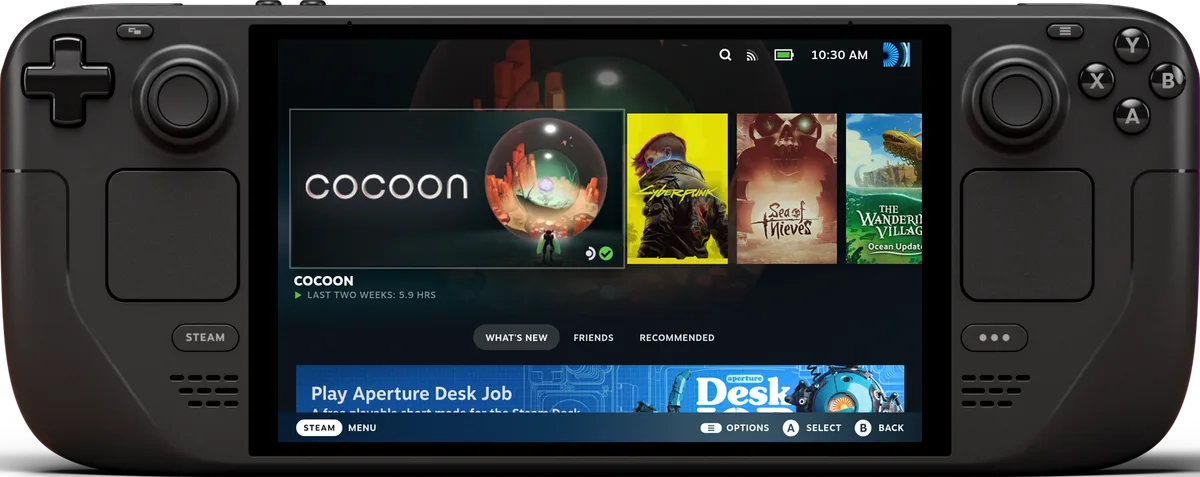
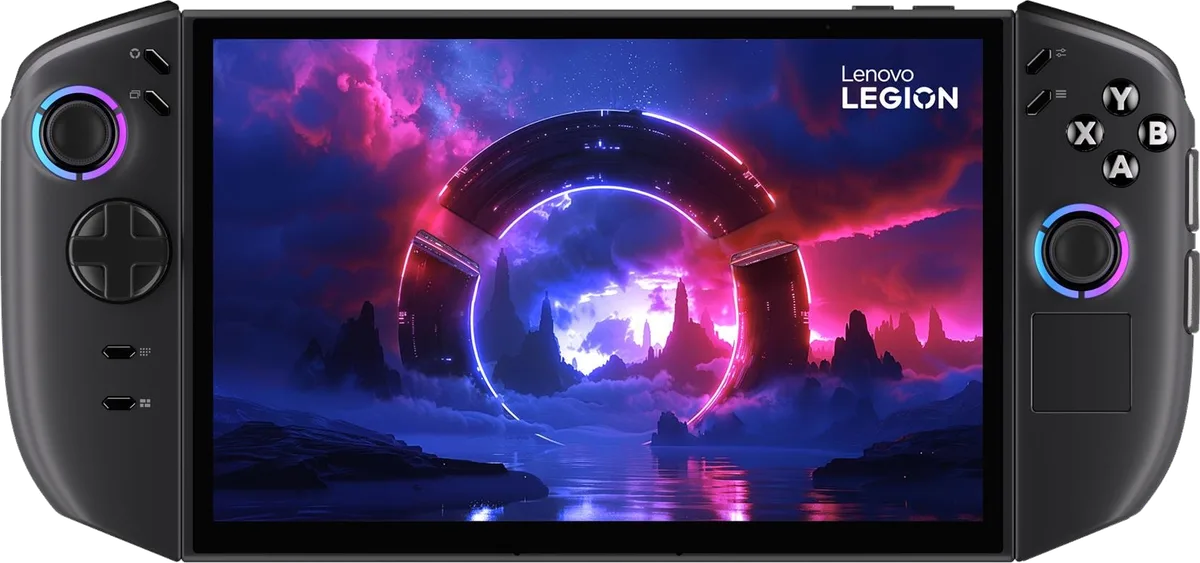
The Legion Go 2 is the bigger, faster, much more expensive handheld: an 8.8-inch 1920x1200 144 Hz OLED with VRR, a Ryzen Z2 Extreme, 32 GB of RAM in the model reviewed, detachable controllers and Windows 11. The Steam Deck OLED is a 7.4-inch 1280x800 90 Hz OLED running SteamOS, 280 g lighter, and reviewers rate its software higher. No outlet we cite benchmarked the two together.
We haven't tested these handhelds ourselves. This guide draws on published reviews, video tests and each device's sourced spec sheet.
Key differences
HandheldQuest calculation from the sourced specs below. Differences under 3% are left out.
- Lenovo Legion Go 2 has 48% more battery capacity (74 Wh vs 50 Wh)
- Lenovo Legion Go 2 is 280 g heavier than Valve Steam Deck OLED (+44%, 920 g vs 640 g)
- Lenovo Legion Go 2 has a 19% larger screen (8.8″ vs 7.4″)
- Lenovo Legion Go 2 has a 60% higher refresh rate (144 Hz vs 90 Hz)
- Lenovo Legion Go 2 has 125% more screen pixels (1920 × 1200 vs 1280 × 800)
- Lenovo Legion Go 2 has 100% more base storage (1 TB vs 512 GB)
- Lenovo Legion Go 2 lists for $590 more than Valve Steam Deck OLED (+75%, $1,379 vs $789, lowest US list price)
Our take
These are different purchases more than rivals. The Legion Go 2 has the larger, higher-resolution, 144 Hz screen, though not clearly a brighter one in SDR, and the speed to run recent games at 1200p with tuning. The Steam Deck OLED has the lighter body, the simpler SteamOS interface and a price several hundred dollars lower.
If you want a handheld that mainly plays your Steam library and you carry it around, I'd start with the Deck. If the screen size, the detachable controllers or the extra speed are what you are paying for, the Go 2 is the one reviewers praise, with a price that most reviewers call steep. I can't give you a head-to-head frame-rate chart, because the sources we cite never ran both; Windows Central's comparison is based on specs.
Elvis
Pick the Steam Deck OLED if
- You want the lowest price of the two and a lighter, 640 g body
- You mostly play from a Steam library and prefer SteamOS to Windows 11 on a handheld
- You accept tuned settings and roughly 30 to 45 fps in demanding recent games
Pick the Legion Go 2 if
- You want an 8.8-inch OLED at 1920x1200 with 144 Hz, VRR and HDR
- You want detachable controllers, a kickstand and Hall effect sticks, and can live with 920 g
- You need Windows for your game library and want the extra speed of the Z2 Extreme
Key specs
| Spec | Steam Deck OLED | Legion Go 2 |
|---|---|---|
| Chip | AMD custom APU | AMD Ryzen Z2 Extreme |
| Software | SteamOS 3 | Windows 11 Home |
| Screen size | 7.4″ | 8.8″ |
| Panel | OLED | OLED |
| Resolution | 1280 × 800 | 1920 × 1200 |
| Refresh rate | 90 Hz | 144 Hz |
| RAM | 16 GB | 16 GB / 32 GB |
| Storage | 512 GB / 1 TB | 1 TB |
| Battery | 50 Wh | 74 Wh |
| Weight | 640 g | 920 g |
| US list price | from $789 | from $1,379 |
Sources for every value are on each handheld's page. See every spec side by side.
Price: the gap is wide
Valve's list prices for the Steam Deck OLED rose on 27 May 2026 to $789 for 512 GB and $949 for 1 TB; they were $549 and $649 at launch. The Legion Go 2 launched at $1,099.99 for the Ryzen Z2 model with 16 GB and $1,349.99 for the Z2 Extreme with 32 GB. The Lenovo's current US price is not stated here.
Reviewers treat the Lenovo's price as its main flaw. Tom's Guide says even the base model costs more than the $999 ROG Xbox Ally X, and Notebookcheck puts the premium for the OLED and detachable controllers at roughly 500 to 600 euros over similar-performance handhelds. Windows Central, writing in January 2026 when the Deck OLED was $549, noted that the SteamOS Legion Go 2's $1,199 starting price was more than double the Deck's.
Reviews of the Deck judged value at launch pricing, when IGN and PC Gamer noted storage had roughly doubled for about the same money. They predate the 2026 increase, so none of the cited reviews covers the Deck's value at $789.
Screen: larger and faster on the Lenovo
Both have OLED panels, and reviewers praise both. The Legion Go 2's is 8.8 inches at 1920x1200 and 144 Hz with VRR and HDR; the Deck's is 7.4 inches at 1280x800 and 90 Hz without VRR. Windows Central's comparison says the Lenovo's panel is better in every way, naming resolution, refresh rate, colour range, size and VRR, and that the size difference feels massive side by side.
Brightness does not follow the same order. Tom's Guide measured 597 nits in SDR and 969 nits with HDR content on the Deck. Tom's Hardware measured 445 nits on the Legion Go 2 and called it dimmer than the Steam Deck OLED, while Notebookcheck got just under 500 nits in SDR and 1,155 cd/m2 peak in HDR. These are different labs and units.
Reviewers of the Deck say the 1280x800 resolution is soft, though the contrast and colour hide much of it. On the Lenovo, PCWorld notes the glossy surface reflects in bright light. (PC Gamer)
Performance: more headroom on the Lenovo
The Legion Go 2 has 8 cores and 16 threads with 16 RDNA 3.5 compute units; the Deck has 4 cores, 8 threads and 8 RDNA 2 units, with a 4 to 15 W power range against the Lenovo's 15 to 35 W. Windows Central's spec-based comparison concludes the Lenovo should run games the Deck cannot. It did not benchmark them.
The reviews give figures for each, but under different conditions. Tom's Hardware measured Shadow of the Tomb Raider at 42 to 47 fps at 1200p on the Legion Go 2, and Windows Central averaged 38.66 fps in Cyberpunk 2077 on its Steam Deck preset at 1200p. Tom's Guide saw Cyberpunk 2077 hold 30 fps on the same preset on the Deck, and Doom Eternal and Spider-Man at 35 to 45 fps on medium. The Deck's screen is 800p, so these are not like-for-like.
Both land short of easy 60 fps in recent games. TechRadar had Deck Verified games such as Deathloop at about 15 fps at default settings, and Tom's Guide reached the mid-50s in Cyberpunk on the Lenovo by hand with FSR 3, after poor maxed-out lab runs. Tom's Hardware also says the Legion Go 2's biggest gains over older Windows handhelds are at 800p.
Battery: bigger pack, but no clear win
The Lenovo's 74 Wh pack is larger than the Deck's 50 Wh. Windows Central expects the Deck to last longer anyway, since the Lenovo's chip and screen draw more power; it had no Legion Go 2 SteamOS runtimes to show, and the Deck's quoted range is three to 12 hours depending on settings.
Measured demanding-game runtimes sit in the same range, from different tests. IGN got about 2.5 hours from the Deck OLED in Cyberpunk 2077 at 50% brightness, TechRadar just over two hours in demanding games at middle brightness, and Tom's Guide a little over two hours in Spider-Man. For the Legion Go 2, Windows Central logged 2 h 17 min in Cyberpunk 2077 at about 200 nits and Tom's Guide 2 h 15 min in its PCMark 10 gaming test, a synthetic run. Tom's Hardware and Tom's Guide call the Lenovo's battery a weakness.
Light use is not comparable here. TechRadar's Deck ran over five hours in Hades 2, while the Lenovo lasted 10 h 45 min in Tom's Guide's web test at 150 nits and 11 h 30 min in Windows Central's office tasks.
Weight, grips and controls
The Deck weighs 640 g and the Legion Go 2 920 g with its controllers attached. Windows Central calls the Lenovo the more ergonomic of the two and notes the controllers detach, so you can prop the screen up on the kickstand. Tom's Hardware often ended sessions with tired hands and wrists, though.
Controls differ in kind. Both have four back buttons. The Deck has two trackpads; the Lenovo has one touchpad on the right controller, an FPS mode, Hall effect sticks and triggers that Windows Central says should not drift. Reviewers of the Deck liked the redesigned concave thumbsticks, and Windows Central says its sticks might drift. (Tom's Guide, GamesRadar+)
On carrying, TechRadar found the Deck's 298 mm body hard to pack alongside a laptop. The Legion Go 2 is 295.6 mm wide, and no cited review compares how the two travel. (Windows Central)
Heat and noise
Tom's Hardware measured the Lenovo's controllers at roughly 84 F, though Windows Central saw its vents peak at 124 F and Notebookcheck found its upper surface warmer than the average handheld under load. The Deck reviews speak of vents and body: IGN measured the OLED model 5 to 10 degrees C cooler than the LCD at the vents, and GamesRadar+ saw about 60 degrees C under load and said the fan rarely drew attention. PCWorld was impressed by how quiet the Lenovo's fans stayed. GamesRadar+ saw about 60 degrees C under load on the Deck and said the fan rarely drew attention, and IGN measured the OLED model 5 to 10 degrees C cooler than the LCD at the vents. Tom's Hardware measured the Lenovo's controllers at roughly 84 F, and PCWorld was impressed by how quiet its fans stayed.
Measured noise only exists for the Lenovo: Windows Central found 35.2 dB at arm's length and 51.3 dB next to the vents, and Notebookcheck 39.7 dB(A) in the standard profile and 46 dB(A) in Manual mode. The Deck reviews give no comparable figures, so a noise comparison is unknown.
Software: SteamOS against Windows 11
The Deck runs SteamOS, and GamesRadar+ and IGN rate it easier to use than Windows 11 on rival handhelds. IGN notes Epic, GOG and itch.io games usually need desktop mode and third-party launchers, and that games with Easy Anti-Cheat, such as Fortnite, do not run.
The Legion Go 2 reviews we cite tested the Windows 11 version, which Tom's Guide and PCWorld call clunky on a handheld. Tom's Hardware praises Legion Space for its quick settings, though it froze while remapping controls, and Windows Central finds it short of Armoury Crate on customization.
Windows Central's January 2026 comparison covers a SteamOS version of the Legion Go 2, then expected in June 2026, with the same interface as the Deck. Its availability and price today are unknown here, and none of the cited reviews tested it.