Head to head
Valve Steam Deck OLED vs ASUS ROG Ally (2023)
By ElvisPublished
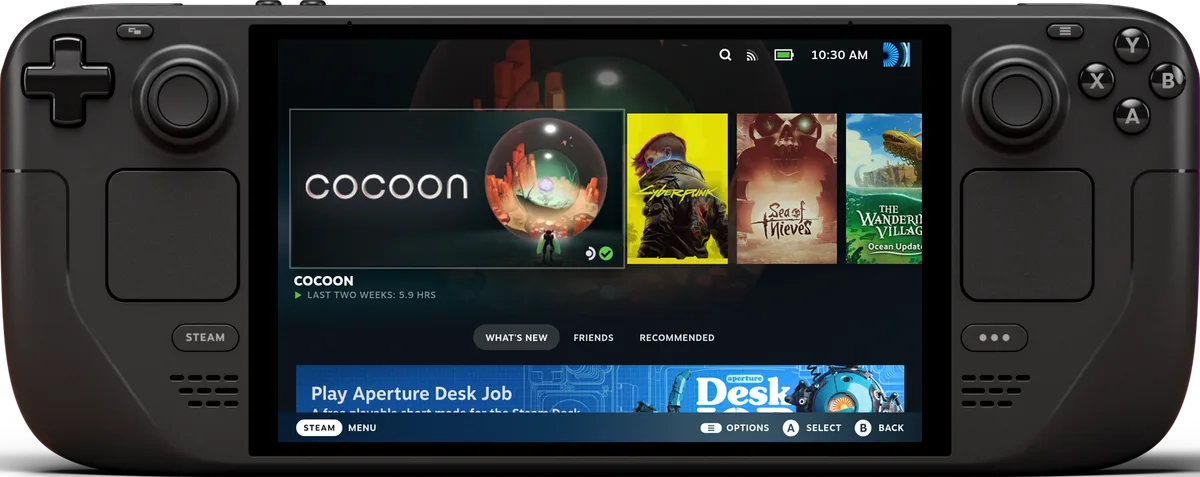
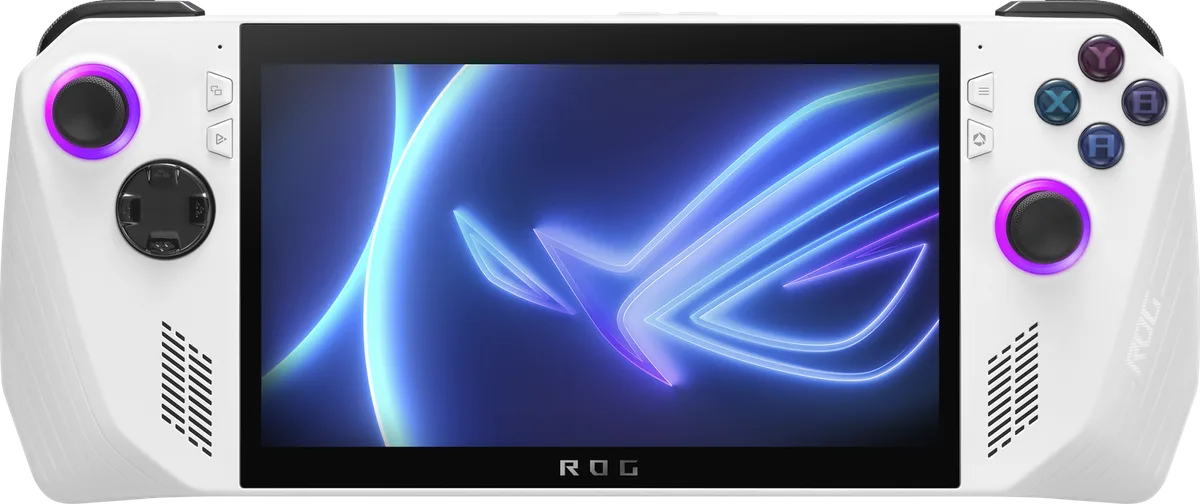
The Steam Deck OLED has the better screen, the longer battery life and the simpler software. The 2023 ROG Ally is faster at matched settings, lighter and runs Windows, so Game Pass and other stores work. Valve now charges $789 for the 512 GB Deck; the Ally has no sourced 2026 price. For a Windows handheld at the Deck's price, BGR points to the 2025 ROG Xbox Ally at $599.99.
We haven't tested these handhelds ourselves. This guide draws on published reviews, video tests and each device's sourced spec sheet.
Key differences
HandheldQuest calculation from the sourced specs below. Differences under 3% are left out.
- Valve Steam Deck OLED has 25% more battery capacity (50 Wh vs 40 Wh)
- Valve Steam Deck OLED is 32 g heavier than ASUS ROG Ally (2023) (+5%, 640 g vs 608 g)
- Valve Steam Deck OLED has a 6% larger screen (7.4″ vs 7″)
- ASUS ROG Ally (2023) has a 33% higher refresh rate (120 Hz vs 90 Hz)
- ASUS ROG Ally (2023) has 102% more screen pixels (1920 × 1080 vs 1280 × 800)
- Valve Steam Deck OLED lists for $89.01 more than ASUS ROG Ally (2023) (+13%, $789 vs $699.99, lowest US list price)
Our take
If the question is which of these two to put in your bag, I'd pick the Deck OLED for most people. The HDR screen, the longer runtime and a system that behaves like a console outweigh a frame-rate lead that reviewers themselves called small once the Ally drops to 720p. Trackpads also make mouse-driven PC games much easier, as IGN notes, and the Ally has none.
The Ally makes sense when you need Windows: Game Pass, Epic or GOG libraries, or a game whose anti-cheat blocks SteamOS. Then you accept short battery life and a rougher interface, and you check the SD card reader history before you trust a microSD with your library. Whichever you lean toward, look at the newer Windows handhelds too, because the 2023 Ally is the older design.
Elvis
Pick the Steam Deck OLED if
- Your library is on Steam and you want the least setup
- You care about an HDR OLED screen and longer battery life
- You want trackpads and a handheld that behaves like a console
Pick the ROG Ally if
- You need Windows for Game Pass, Epic or anti-cheat games
- You want higher frame rates at matched settings in a lighter body
- You can live with short battery life in demanding games
Key specs
| Spec | Steam Deck OLED | ROG Ally |
|---|---|---|
| Chip | AMD custom APU | AMD Ryzen Z1 Extreme |
| Software | SteamOS 3 | Windows 11 Home |
| Screen size | 7.4″ | 7″ |
| Panel | OLED | IPS LCD |
| Resolution | 1280 × 800 | 1920 × 1080 |
| Refresh rate | 90 Hz | 120 Hz |
| RAM | 16 GB | 16 GB |
| Storage | 512 GB / 1 TB | 512 GB |
| Battery | 50 Wh | 40 Wh |
| Weight | 640 g | 608 g |
| US list price | from $789 | from $699.99 |
Sources for every value are on each handheld's page. See every spec side by side.
Price and which versions are sold
Valve raised Steam Deck OLED prices on 27 May 2026 to $789 for 512 GB and $949 for 1 TB, up from $549 and $649 at launch. The ROG Ally launched in 2023 at $699.99 for the Ryzen Z1 Extreme model with 16 GB and 512 GB; that launch price is not a current price.
ASUS also sold a cheaper Ryzen Z1 version with six cores and four RDNA 3 compute units, and its product page still lists both configurations with retailer links. Our spec data holds no current list price for either, so check the ASUS eShop and Best Buy before comparing it with Valve's price. The Z1 Extreme is the one the reviews tested.
BGR's August 2026 comparison calls the Deck OLED the better piece of hardware, yet recommends ASUS's handhelds for buyers in 2026 largely because of Valve's pricing. Its price case rests on the 2025 ROG Xbox Ally at $599.99 with 16 GB and 512 GB, not the 2023 Ally, and it lists the ROG Xbox Ally X at $999.99.
Performance
The Ally's Z1 Extreme has eight Zen 4 cores and 12 RDNA 3 compute units at 9 to 30 W. The Deck OLED has four Zen 2 cores and eight RDNA 2 compute units at 4 to 15 W. At 720p, highest preset and 15 W, IGN measured 38, 57 and 64 fps in Total War: Three Kingdoms, Borderlands 3 and Hitman 3 on the Ally, against 25, 42 and 44 fps on the LCD Steam Deck at its native 800p.
The lead shrinks at native resolution. Tom's Guide saw Doom Eternal at 35 to 45 fps and Cyberpunk 2077 near 30 fps at 1080p on the Ally and called its gain over the Deck arguably negligible once the Ally drops to 720p. Reviewers of the Deck OLED measured frame rates within a few fps of the LCD model, which is the Deck those Ally reviews compared against. (IGN, GamesRadar+)
Power mode matters on the Ally. Notebookcheck says only Turbo mode gives full speed, although its repeat runs in Performance mode were only 1 to 2 fps behind. GamesRadar+, IGN and TechRadar all note in their Deck OLED reviews that Z1 Extreme handhelds such as the ROG Ally post higher frame rates, but cost more.
Screen
The Deck OLED has a 7.4-inch 1280x800 HDR panel at 90 Hz. Tom's Guide measured 597 nits in SDR and 969 nits with HDR content, with 101.8% DCI-P3 coverage. PC Gamer says the contrast and colour help hide the low resolution.
The Ally has a 7-inch 1920x1080 IPS panel at 120 Hz with FreeSync. Reviewers measured peaks of 465 to 524 nits and found it sharper and faster than the original Deck's LCD. Reviewed measured a 1190:1 contrast ratio and said it is not OLED black. Notebookcheck measured a raised black level and says blacks look dark grey next to OLED. IGN and PCWorld both criticise the thick bezels. (Tom's Guide)
Battery life
Battery life is the original Ally's weak point. Its cell is 40 Wh, against 50 Wh in the Deck OLED. IGN says to expect 1 to 2 hours in graphically intensive games, and Notebookcheck's Witcher 3 test at 150 nits lasted 57 minutes in Turbo mode. PCWorld's sessions always hit 0% in under two hours.
The Deck OLED lasted just over two hours in demanding games at middle brightness for TechRadar, and IGN got about a full hour more than the LCD model in Cyberpunk 2077. TechRadar got over five hours in the lighter Hades 2. Reviewed found the Deck better than the Ally at low-power play, where the Ally managed a bit under three hours in Silent mode.
Software, Game Pass and anti-cheat
SteamOS is the simpler system. GamesRadar+ and IGN rate it easier to use than Windows 11 on rival handhelds. Tom's Guide says Armoury Crate is far less intuitive, that many launchers ignore the controller and that the Ally has no equivalent of Deck Verified. PCWorld counted dozens of bugs at launch, and Reviewed still hit a touchscreen failure after a restart. Notebookcheck was more positive about Armoury Crate SE. These reviews date from 2023, so some problems may be fixed.
Windows 11 is the reason to buy the Ally. IGN credits the freedom to use Epic, GOG and Xbox stores, and the Ally shipped with three months of Game Pass Ultimate. On the Deck, IGN says Epic, GOG and itch.io games usually need desktop mode and third-party launchers, and its review says games with Easy Anti-Cheat such as Fortnite and Call of Duty: Warzone remain unplayable on SteamOS. BGR adds that Windows updates can introduce new bugs.
Controls and comfort
The Ally weighs 608 g and the Deck OLED 640 g. The Deck has two 32.5 mm haptic trackpads and four back buttons, and the Ally has no touchpads. IGN lists the missing pressure-sensitive touchpads as a point for the Steam Deck. Tom's Guide and Notebookcheck found the Ally comfortable for long sessions yet say the Deck's thicker grips are better. Reviewers also praise the Deck OLED's more concave thumbsticks. (Tom's Guide)
The Ally's microSD reader problem
In July 2023 ASUS confirmed on its ROG forum that under certain thermal stress conditions the Ally's SD card reader may malfunction. HotHardware ties it to the slot sitting above an exhaust vent. ASUS promised an update that fine-tunes the default and minimum fan speeds, and The Register reports that units that had already failed needed service from ASUS. The Register called it unclear whether the fan change would be enough, and no later report cited here confirms a fix.
The Ally has a UHS-II microSD reader and the Deck OLED a UHS-I slot. If you plan to hold a large library on a card, this history is a reason to be careful with the Ally or to buy the Deck.