AMD chip
Steam Deck APU
By ElvisPublished
The Steam Deck's custom AMD APU is a four-core Zen 2 chip with an 8 compute unit RDNA 2 GPU in a 4 to 15 W range. It's one of the oldest designs in a current PC handheld, and its low resolution target, SteamOS and efficiency at low power keep it competitive in lighter games and older AAA titles.
We haven't tested these handhelds ourselves. This guide draws on published reviews of the handhelds built on this chip, and on Valve's own specifications.
Our take
Spec for spec, the Deck's chip is outclassed by AMD's Z1 and Z2 Extreme and Intel's newer handheld chips. That it still matters says a lot about Valve's software and the 800p screen it was built for.
If you play new AAA releases, the chip is the reason to look elsewhere. If your library is indies, older AAA and games Valve has Verified, it's still enough, and reviewers keep finding it more efficient at low power than its faster rivals.
Elvis
Specifications
| CPU | Zen 2 |
|---|---|
| Cores / threads | 4 / 8 |
| CPU clock | 2.4–3.5 GHz |
| GPU | AMD RDNA 2, up to 1.6 TFLOPS FP32 |
| GPU CUs | 8 |
| GPU clock | up to 1.6 GHzGPU clock range 1.0 to 1.6 GHz per Valve. |
| Power (TDP) | 4–15 W |
Source: Valve, Steam Deck APU specifications, checked October 23, 2026. Each handheld sets its own power limits within this range.
Gaming handhelds with the Steam Deck APU
Valve · SteamOS 3
Steam Deck OLED
$789MSRP
- Chip
- AMD custom APU
- Display
- 7.4″ 90 Hz OLED
- Battery
- 50 Wh
- Weight
- 640 g
Valve · SteamOS 3
Steam Deck LCD
$349MSRP
- Chip
- AMD custom APU
- Display
- 7″ 60 Hz IPS LCD
- Battery
- 40 Wh
- Weight
- 669 g
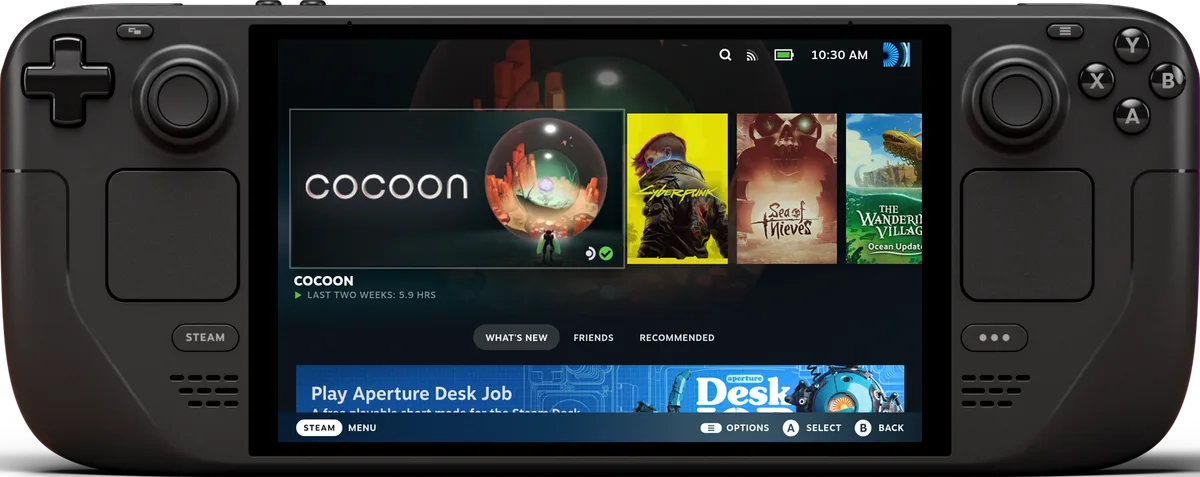
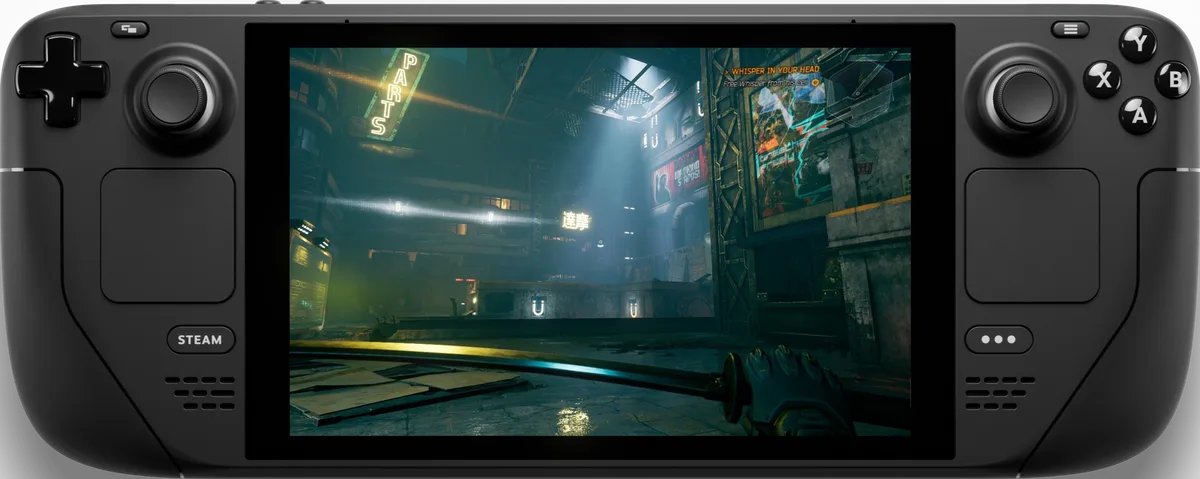
Specs
Valve lists a Zen 2 CPU with four cores and eight threads at 2.4 to 3.5 GHz, an RDNA 2 GPU with eight compute units at 1.0 to 1.6 GHz (up to 1.6 TFLOPS FP32), and a 4 to 15 W APU power range. The Steam Deck OLED moved the chip from 7 nm to 6 nm.
Performance
The OLED's die shrink didn't raise performance. In IGN's tests every game landed within 3 fps of the original Deck, and GamesRadar+ measured near-identical Cyberpunk 2077 results.
Tom's Guide saw Doom Eternal and Marvel's Spider-Man at 35 to 45 fps on medium, and Cyberpunk 2077 holding 30 fps on its Steam Deck preset. TechRadar found some Verified games ran poorly at default settings, with Deathloop at about 15 fps.
Windows rivals are faster. At 720p in 15 W mode, IGN measured the Z1 Extreme ROG Ally at 38, 57 and 64 fps in three games where the Deck managed 25, 42 and 44 fps. Reviewed still found the Deck better at low-power play.
Battery and heat
The OLED model's 6 nm chip and 50 Wh battery helped battery life more than speed. IGN got a full hour more from the OLED than the LCD model in Cyberpunk 2077 at 50% brightness, and IGN's thermal tests showed hotspots 5 to 10 °C cooler.
Against the Switch 2, The Phawx found the Deck about 24% faster in Cyberpunk 2077 at 24 W of system power, while the Switch 2 delivered 2.5 times the Deck's frame rate at 8.6 W, according to Notebookcheck's write-up.
Other AMD chips in gaming handhelds
| Chip | Cores | GPU CUs | TDP | Handhelds |
|---|---|---|---|---|
| AMD Ryzen Z1 Extreme | 8 | 12 | 9–30 W | 3 |
| AMD Ryzen Z2 Extreme | 8 | 16 | 15–35 W | 2 |
| AMD Ryzen AI Z2 Extreme | 8 | 16 | 15–35 W | 2 |
| AMD Ryzen Z2 A | 4 | 8 | 6–20 W | 1 |
| AMD Ryzen Z2 Go | 4 | 12 | 15–30 W | 1 |
| AMD Ryzen 7 8840U | 8 | 12 | 15–30 W | 10 |
| AMD Ryzen 7 8840HS | 8 | 12 | 20–30 W | 3 |
| AMD Ryzen AI 9 HX 370 | 12 | 16 | 15–54 W | 9 |
| AMD Ryzen AI Max+ 395 | 16 | 40 | 45–120 W | 4 |
| AMD Ryzen AI Max 385 | 8 | 32 | 45–120 W | 1 |
| AMD Ryzen 7 7840U | 8 | 12 | 15–30 W | 2 |
| Steam Deck APU | 4 | 8 | 4–15 W | 2 |
GPU units are counted the way each maker counts them, so AMD compute units and Intel Xe-cores aren't comparable one to one.