Buying guide
Best handheld gaming PC in 2026: five picks by budget and priority
Which handheld gaming PC to buy: the Steam Deck OLED, ROG Xbox Ally X, Legion Go S, Legion Go 2 and MSI Claw 8 EX AI+, picked from published reviews.
By ElvisPublished Updated
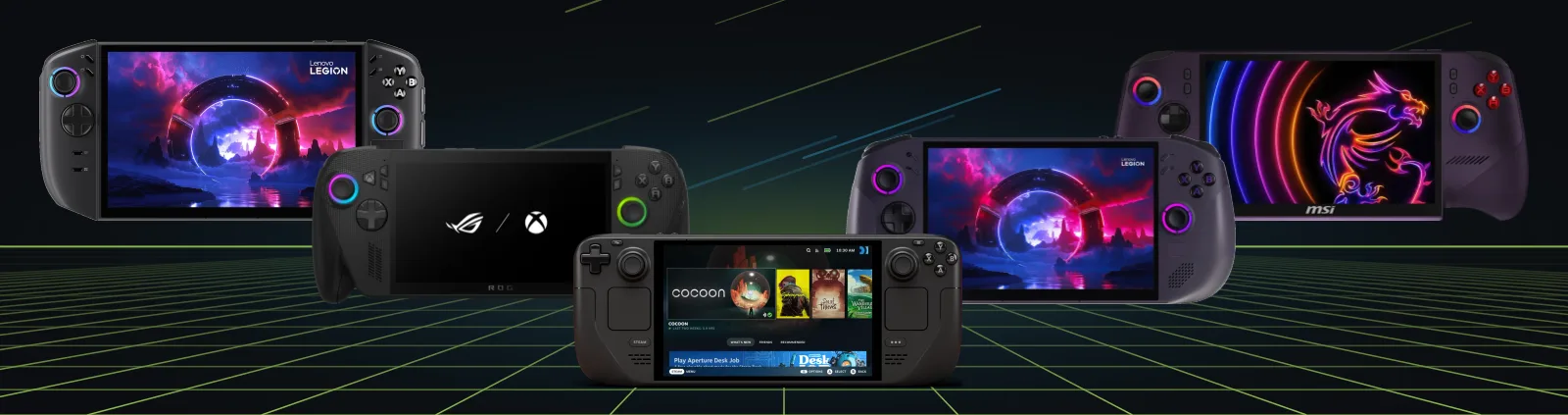
Buy the Steam Deck OLED if you mostly play on Steam and want the least fuss. Buy the ROG Xbox Ally X if you want a faster Windows handheld with Game Pass and other PC stores. The Legion Go S with SteamOS is the alternative to the Deck if you want a bigger 120 Hz screen. The Legion Go 2 has the best screen and the MSI Claw 8 EX AI+ the highest measured speed, and both cost a lot.
The labels below are our picks from published reviews. Every price is a US list price with the date it applies from, never a deal price. Handheld prices have been moving in 2026, so check the current price before you buy.
Best overall: Steam Deck OLED
If your library lives on Steam, start here. Most of the appeal is SteamOS: GamesRadar+ rates it easier to use than Windows 11 on rival handhelds, and IGN likes the quality-of-life features SteamOS brings.
The 7.4-inch HDR OLED is the other draw. Tom’s Guide measured 597 nits peak brightness and 969 nits with HDR content. PC Gamer says the 90 Hz refresh rate makes games running at 30 to 40 fps feel smoother. On battery, IGN got a full extra hour in Cyberpunk 2077 at 50% brightness compared with the LCD model, and its thermal tests showed hotspots 5 to 10 °C cooler.
The weak spot is raw speed, which is the same as the older LCD model. Tom’s Guide saw Cyberpunk 2077 hold 30 fps on its Steam Deck preset, and TechRadar saw Deathloop at about 15 fps at default settings. IGN adds that games with Easy Anti-Cheat, such as Fortnite, do not run on SteamOS.
Valve raised the price in 2026: the 512 GB model went from $549 to $789, much closer to the Windows handhelds below.
$789 list price (512 GB) as of 2026-05-27; the 1 TB model is $949. Compare it with the Windows option in our Steam Deck OLED vs ROG Xbox Ally X piece, or see the spec page and review roundup.
Best for Windows performance: ROG Xbox Ally X
This one suits players with large PC libraries, Game Pass subscriptions or games that need Windows anti-cheat. Notebookcheck measured 14% higher gaming results than the 2024 Ally X, and its 17 W Performance mode roughly matched the old model’s 25 W Turbo mode. GamesRadar+ measured a 54 fps average in Cyberpunk 2077 at 1080p in 25 W Turbo mode.
Comfort gets the loudest praise. Tom’s Guide calls it the most comfortable handheld it has used, and Notebookcheck says the 718 g weight was no issue. Tom’s Hardware calls the Xbox full-screen mode significantly better than standard Windows 11, though it is not as polished as SteamOS.
The complaints are about battery life and price. Windows Central logged 1 h 53 min in Cyberpunk 2077 at 25 W and 60% brightness. Notebookcheck expects about 4 hours in Silent mode, after measuring 2:13 in Turbo and 3:12 in Performance. The 1080p IPS panel has no HDR, per Tom’s Hardware, and TechRadar scored value 2 out of 5.
Tom’s Hardware notes that the price is up from the $799 the 2024 Ally X launched at. If you own that model, see ROG Ally X vs ROG Xbox Ally X first.
Two newer options cost $300 more than the Ally X and the same as each other. The ROG Xbox Ally X20 adds a 7.4-inch 1080p 120 Hz OLED screen to the same chip, at $1,299.99 as of 2026-08-25. The Acer Predator Atlas 8 runs Intel’s Arc G3 Extreme, the chip in the MSI Claw pick below, and sells for $1,299.99 in the US as of 2026-10-23, $500 less than the Claw. Neither has a review roundup here yet.
$999.99 list price as of 2025-10-16. See the spec page and review roundup.
SteamOS alternative to the Deck: Legion Go S
Lenovo’s Legion Go S is the first licensed SteamOS handheld from another maker. It suits people who like the Deck’s software but want a bigger screen: 8 inches at 1920x1200 and 120 Hz. Android Authority and Pocket Tactics credit the SteamOS version with variable refresh rate, which the Steam Deck lacks. T3 judges it the best handheld PC it has tested for ergonomics.
Software is what separates the versions. Tom’s Guide, Android Authority and Pocket Tactics all rate the SteamOS version far above the Windows one. Tom’s Guide and Tom’s Hardware, reviewing the Windows model, found Windows 11 a poor fit for a handheld. Android Authority said it could not recommend that version to anyone.
Battery life is short. Android Authority puts demanding AAA play at 90 to 120 minutes. Fans are another caveat on the faster Z1 Extreme model: T3 says they get loud almost regardless of the game. The cheaper Z2 Go version ran most games well in Pocket Tactics’ review, though The First Descendant stuttered.
The SteamOS Z2 Go model (16 GB, 512 GB) was listed at $599.99 as of 2025-06-15, and the Z1 Extreme model (32 GB, 1 TB) at $829 as of 2025-08-27; reviewers quoted between $829 and $899 for that model. Retail prices have moved since those reviews, so check current listings. The Steam Deck OLED vs Legion Go S comparison sets the two side by side. See also the spec page and review roundup.
Best screen: Legion Go 2
Choose this if image quality and flexibility matter more to you than weight. Windows Central calls the 8.8-inch 1920x1200 OLED the best OLED handheld display so far. Notebookcheck measured 1,155 cd/m² peak in HDR and just under 500 cd/m² in SDR.
The detachable controllers help too. Tom’s Guide, Windows Central and Tom’s Hardware say the rounded redesign is more comfortable than the original, and they praise the Hall effect sticks. Tom’s Hardware and PCWorld both liked the kickstand.
It is heavy and costs a lot. Tom’s Hardware and Tom’s Guide put the weight with controllers attached at about 2 lb. Tom’s Guide’s PCMark 10 gaming test lasted 2 h 15 min, an hour less than the ROG Ally X. Windows 11 is the most repeated complaint, and Tom’s Guide says even the base model costs more than the $999 ROG Xbox Ally X.
The list prices are $1,349.99 for the Ryzen Z2 Extreme model with 32 GB and 1 TB, and $1,099.99 for a base Z2 model with 16 GB, both as of 2025-09-05. Retail prices rose sharply in 2026, according to Notebookcheck’s April report on another price hike, so expect to pay more than list. A SteamOS edition from $1,199 was announced in January 2026, per Notebookcheck. Our ROG Xbox Ally X vs Legion Go 2 comparison covers the choice between the two Windows models. The spec page and review roundup have the rest.
Best high-end: MSI Claw 8 EX AI+
This is the pick for enthusiasts who want the fastest Windows handheld reviewers have measured. Tom’s Hardware measured a 20 to 30+ fps lead over its peers across its benchmark suite. PC Gamer’s table put it first in every game except one older upscaling test. Engadget’s larger gains came from an Intel engineering sample with pre-production drivers, so read them with care.
Battery life beats the AMD rivals, mostly through Endurance mode. Notebookcheck measured 3:19 in Cyberpunk 2077 at 150 nits in Endurance mode, against 1:39 at 35 W. PC Gamer saw its PCMark gaming test go from two and a half hours to over five in Endurance mode. PC Gamer and Notebookcheck also praise the redesigned chassis.
Most of the criticism is about price. Tom’s Hardware calls the missing OLED a big miss at this price, and reviewers tie the cost to the memory shortage. Engadget says frame generation and Endurance mode settings sit partly outside the quick menu. Notebookcheck measured fans that run constantly.
Our Claw 8 EX AI+ vs ROG Xbox Ally X comparison puts the speed gap against the $800 price gap.
$1,799 list price (32 GB) as of 2026-06-23. See the spec page and review roundup.
How we picked
HandheldQuest does not test devices. These picks rest on published reviews from named outlets, cited above with their dates, and on the makers’ spec sheets and list prices. Where reviewers disagree, we say who found what. Review dates run from 2023 to 2026, and software updates can change battery and performance after a review appears.
We limited the picks to handhelds on sale now and favored those with a review roundup on this site. “Best overall” and the other labels are our reading of who each device fits. Prices are list prices from the maker or a launch report, shown with the date they apply from. We do not show retailer prices.
Sources
- Steam Deck OLED Review · IGN · Review · November 9, 2023
- Steam Deck OLED review · PC Gamer · Review · November 9, 2023
- Steam Deck OLED review: Valve's new handheld has reclaimed my heart · GamesRadar+ · Review · February 21, 2024
- Steam Deck OLED review: a decent upgrade, but left me wanting more · TechRadar · Review · August 30, 2024
- Steam Deck back in stock, with updated pricing · Valve · Manufacturer · May 27, 2026
- ROG Xbox Ally X review: Is this an Xbox? · Tom's Guide · Review · October 15, 2025
- Asus ROG Xbox Ally X review: Getting a grip on Windows gaming · Tom's Hardware · Review · October 15, 2025
- Xbox Ally X review: Next-level comfort and performance · Windows Central · Review · October 15, 2025
- Full-screen Xbox experience for gaming handhelds - Asus ROG Xbox Ally X review · Notebookcheck · Review · October 16, 2025
- ROG Xbox Ally and Ally X pricing revealed at TGS 2025 · The Outerhaven · News · September 25, 2025
- Lenovo Legion Go S with Steam OS fixes so much, but can it beat a Steam Deck? · Android Authority · Review · June 15, 2025
- Lenovo Legion Go S SteamOS review - finally, a true Steam Deck rival · Pocket Tactics · Review · August 27, 2025
- Lenovo Legion Go S (SteamOS) review: Improving on the Steam Deck · T3 · Review · November 5, 2025
- Lenovo Legion Go 2 review: A great handheld hampered by its steep price · Tom's Guide · Review · September 5, 2025
- Lenovo Legion Go 2 review: The best handheld screen ever · Windows Central · Review · October 2, 2025
- Lenovo Legion Go 2 review: AMD's Ryzen Z2 Extreme makes gains at 800p · Tom's Hardware · Review · October 2, 2025
- Gaming handheld with great 144 Hz OLED and detachable controllers - Lenovo Legion Go 2 review · Notebookcheck · Review · February 14, 2026
- Lenovo releases Legion Go 2 for $1,349 with AMD Ryzen Z2 Extreme and 32 GB RAM · Notebookcheck · News · September 5, 2025
- MSI Claw 8 EX AI+ review: Unmatched performance and a jaw-dropping price tag · Tom's Hardware · Review · June 23, 2026
- MSI Claw 8 EX AI+ review: Big money for big performance · Engadget · Review · June 23, 2026
- MSI Claw 8 EX AI+ CG3EM review · PC Gamer · Review · July 21, 2026
- Intel's Arc G3 Extreme changes the handheld game - MSI Claw 8 EX AI+ Review · Notebookcheck · Review · June 23, 2026
- Steam Deck OLED review: The best handheld just got even better · Tom's Guide · Review · November 16, 2023
- ROG Xbox Ally X review · GamesRadar+ · Review · October 15, 2025
- Asus ROG Xbox Ally X: not quite the console-like experience you were looking for · TechRadar · Review · October 15, 2025
- ROG Xbox Ally X20 (2026) specifications · ASUS ROG · Manufacturer · August 25, 2026
- The OLED ROG Xbox Ally X20 starts at $1,299 · Shacknews · News · August 25, 2026
- Acer's New $1299 Predator Atlas 8 Intel Arc G3 Extreme Handheld Gaming PC Is Now Available at Best Buy · IGN · News · October 23, 2026
- Lenovo Legion Go S review (Windows 11, Ryzen Z2 Go) · Tom's Guide · Review · January 7, 2025
- Lenovo Legion Go S Review: Where's the Beef? (Windows 11, Ryzen Z2 Go) · Tom's Hardware · Review · February 16, 2025
- Lenovo Legion Go S review (SteamOS, Ryzen Z1 Extreme) · Tom's Guide · Review · May 31, 2025
- Lenovo Legion Go 2 review: A gaming handheld dripping with luxury · PCWorld · Review · October 2, 2025
- Lenovo Legion Go 2 gets another price hike, pushing it to $2,000 · Notebookcheck · News · April 3, 2026
- Lenovo Legion Go 2 gets a SteamOS edition with a starting price of $1,199 · Notebookcheck · News · January 7, 2026
Spotted a mistake or a step that no longer works? Tell us and we'll correct it.